
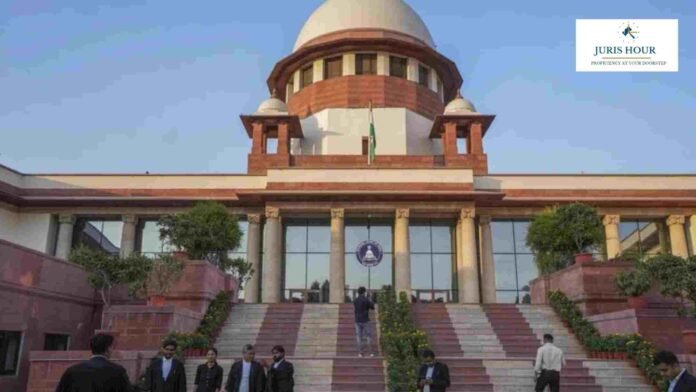
The Supreme Court has held that the State of Assam cannot deny regularization benefits to eligible Muster Roll and Work Charged workers who were left out due to clerical errors and administrative lapses, while extending the same benefit to nearly 30,000 similarly situated employees.
The bench of Justice Vikram Nath and Justice Sandeep Mehta ruled that such selective treatment violates the constitutional guarantee of equality under Article 14 and emphasized that a State acting as a “model employer” cannot take inconsistent positions to defeat legitimate claims of workers.
The judgment arose from a batch of appeals led by Sukhendu Bhattacharjee & Others v. State of Assam, where workers engaged prior to 1 April 1993 challenged the Gauhati High Court Division Bench ruling that had denied regularization benefits. The Supreme Court examined whether workers excluded due to administrative mistakes could be denied the same treatment that had been granted to thousands of others under the State’s regularization policy.
The dispute traces back to Assam’s long-standing practice of engaging Muster Roll workers beginning in the 1980s for construction, maintenance and public works across the State. Over time, the Assam Government adopted several policy measures for regularization of these workers. In 1995, the State issued directions for regularizing workers engaged prior to 1 April 1993 and subsequently reiterated such decisions through multiple circulars.
A major development occurred in July 2005 when the Assam Cabinet decided to regularize Work Charged and Muster Roll workers who had been engaged before 1 April 1993 and were in continuous service without interruption. Pursuant to this decision, the State approved the creation of more than 30,000 posts, including 25,069 Grade-IV posts and 5,892 Work Charged posts, for implementing the regularization exercise.
However, despite this large-scale regularization drive, many eligible workers were excluded because of clerical mistakes, spelling errors and administrative oversights. These workers approached courts claiming that although they fulfilled all eligibility requirements and had rendered decades of service, they had been denied benefits granted to others identically placed.
The State later issued a 2012 Office Memorandum taking the position that no further regularization of Work Charged or Muster Roll workers would be undertaken, even for those engaged before the cut-off date. The affected workers challenged this policy.
The Supreme Court observed that the appellants stood on exactly the same footing as the 30,000 workers already regularized by the Government. According to the Court, the exclusion of the appellants was not attributable to any fault on their part but resulted entirely from administrative deficiencies of the State machinery.
Rejecting the State’s reliance on the Constitution Bench decision in Secretary, State of Karnataka v. Umadevi, the Court held that the present dispute did not arise from a fresh claim for regularization under the limited one-time exception carved out in Umadevi. Instead, the issue concerned equal treatment among persons covered by an existing State policy which had already been implemented for a large section of workers.
The Court emphasized that once a policy decision has been made for a defined category of workers, the State cannot selectively extend benefits to one group while denying them to another equally situated group without any rational basis. It reiterated that equality under Article 14 requires uniform implementation of a policy for all eligible beneficiaries.
The Bench was also critical of the conduct of the Assam Government in giving repeated assurances before the High Court regarding formulation of a regularization policy and later attempting to withdraw from those commitments by citing legal obstacles. The Court observed that the State, as a model employer, cannot secure time and relief from constitutional courts through assurances and subsequently take an inconsistent position.
Further, the Supreme Court held that the State’s conduct had created a legitimate expectation among the excluded workers that they would be considered fairly and uniformly under the same regularization framework. The Court noted that while legitimate expectation may not create an absolute right, it forms an important component of administrative fairness and non-arbitrariness under Article 14.
Case Details
Case Title: Sukhendu Bhattacharjee And Others Versus The State Of Assam And Others
Citation: JURISHOUR-1340-SC-2026
Case No.: Civil Appeal No(S). 4514 Of 2025
Date: 21/05/2026

