
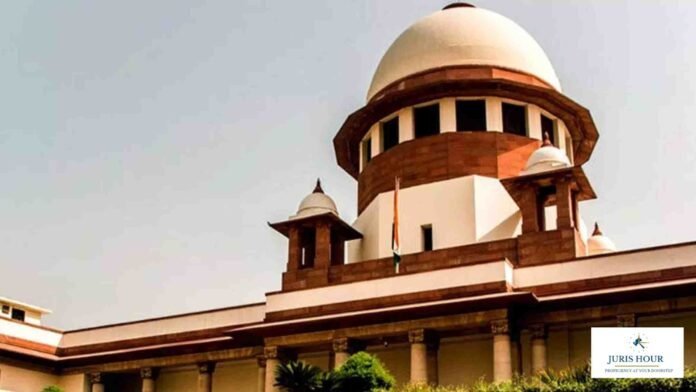
The Supreme Court has upheld the entitlement of landowners to receive additional amenity Transferable Development Rights (TDR) for developing public amenities on surrendered land and ruled that such statutory compensation cannot be denied on the grounds of waiver, contractual conditions, or delay in making the claim.
The bench of Justice J.K. Maheshwari and Justice Atul S. Chandurkar) dismissed the challenge filed by the Brihanmumbai Municipal Corporation (BMC) against a Bombay High Court judgment that had granted relief to Vijay Nagar Apartments and others.
The dispute arose from land situated at Bhakti Park, Chembur, which had been reserved for a public garden under the Maharashtra Regional and Town Planning Act, 1966 (MRTP Act). Under Section 126(1)(b) of the MRTP Act, the landowner had surrendered the land to the Corporation and developed the garden at its own cost. While TDR corresponding to the surrendered land was granted, the Corporation later refused to provide additional amenity TDR for development of the garden.
The Corporation relied upon a Letter of Intent, an undertaking, and a maintenance agreement executed by the landowner, under which the landowner had agreed not to claim additional amenity TDR and instead maintain the garden for twenty years. It also argued that the claim was made after nearly 17 years and therefore was barred by delay and laches. Further, BMC contended that the Development Control Regulations, 1991 had already been replaced by the Development Control and Promotion Regulations, 2034, which did not contain any provision granting such additional TDR.
Rejecting these contentions, the Supreme Court emphasized that the right to fair compensation for acquired property under Section 126(1)(b) is a statutory entitlement and cannot be curtailed through private agreements or executive conditions. The Court observed that compensation under the statutory scheme consisted of two components: one against the surrendered land itself and another against the development of an amenity on such land at the owner’s cost.
The Court noted that a garden squarely falls within the statutory definition of “amenity” under the MRTP Act and the Development Control Regulations. Therefore, once the landowner had developed the garden on the surrendered land, the statutory right to claim additional TDR accrued in its favour.
On the issue of waiver, the Supreme Court held that the Corporation could not replace a statutory compensation mechanism with a maintenance arrangement created through contractual stipulations. The Court observed that allowing authorities to impose additional conditions outside the statutory framework would undermine legislative intent and place landowners in an unequal bargaining position.
The Court also rejected the Corporation’s argument that the claim was barred by delay. Referring to earlier precedents including the Godrej & Boyce and Kukreja Construction decisions, the Bench reiterated that claims relating to compensation cannot ordinarily be defeated merely because the claimant approached at a later stage. The Court noted that once compensation in the form of TDR is legally determined, the State carries a duty to grant it.
Further, the Bench clarified that the right to additional amenity TDR crystallized when the land was surrendered in 2002 and therefore subsequent regulatory changes under DCPR 2034 could not extinguish that already accrued right.
Case Details
Case Title: Brihanmumbai Municipal Corporation And Ors. Versus ITO
Citation: JURISHOUR-1318-SC-2026
Case No.: SLP (C) No. 11541 of 2024
Date: 20/05/2026

