
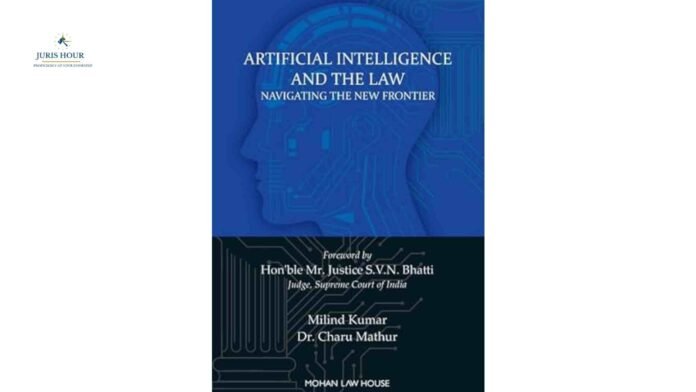
As artificial intelligence rapidly moves from laboratories into courtrooms, regulatory agencies, businesses, and governance systems, Artificial Intelligence and the Law – Navigating the New Frontier arrives as a timely and intellectually grounded contribution to contemporary legal scholarship. Authored by Milind Kumar and Dr. Charu Mathur, with a foreword by Hon’ble Mr. Justice S.V.N. Bhatti of the Supreme Court of India, the book distinguishes itself by rejecting sensationalism and instead treating AI as an immediate institutional and governance challenge.
The book’s greatest strength lies in its refusal to view artificial intelligence as a futuristic abstraction. Instead, it approaches AI as a functioning reality already embedded within existing legal and administrative systems. The authors convincingly argue that AI does not operate outside the law. Whether deployed by governments, corporations, courts, or digital platforms, AI systems remain subject to constitutional safeguards, procedural fairness, labour protections, tort liability, contractual obligations, and principles of judicial review.
Rather than asking whether the law applies to AI, the book focuses on the more pressing question: how traditional legal doctrines must adapt when decision-making processes are increasingly influenced by automated systems. This framing gives the work both clarity and practical relevance.
A notable feature of the book is its institution-focused analysis. The discussion is not speculative or dominated by distant technological hypotheticals. Instead, the chapters are rooted in present-day legal realities, examining how AI intersects with governance, adjudication, public administration, and regulatory enforcement. The analysis is supported through statutes, case law, comparative jurisprudence, and emerging regulatory frameworks across multiple jurisdictions.
The comparative law dimension is particularly valuable. By examining approaches adopted in India, the European Union, the United States, and the United Kingdom, the authors provide readers with a nuanced understanding of how different legal systems respond to common AI-related challenges. These comparisons are not merely descriptive; they are used analytically to identify safeguards, accountability structures, procedural protections, and regulatory limits applicable to AI-driven decision-making.
Another important contribution of the book is its emphasis that technological efficiency cannot override legality. The authors repeatedly stress that improvements in speed, scalability, or administrative convenience cannot dilute constitutional principles such as fairness, proportionality, due process, transparency, and reasoned decision-making. This theme gives the book a strong normative foundation and makes it especially relevant for policymakers, judges, regulators, and legal practitioners confronting increasing automation within public systems.
The book also stands out for incorporating a distinct Global South perspective. Much of the global discourse on AI governance is often dominated by Western institutional assumptions. Here, however, the authors recognise that AI governance challenges in developing jurisdictions differ significantly due to issues of population scale, welfare administration, digital public infrastructure, and varying institutional capacities. This perspective adds considerable depth and relevance, particularly in the Indian context.
From a readability standpoint, the work succeeds in balancing academic rigour with accessibility. Legal professionals, policymakers, students, researchers, and even technology stakeholders without deep legal backgrounds can engage meaningfully with its arguments. The writing remains analytical yet practical throughout.
In an era where AI regulation is evolving faster than many legal institutions can adapt, Artificial Intelligence and the Law – Navigating the New Frontier serves as a thoughtful and grounded guide. It neither glorifies nor demonises artificial intelligence. Instead, it asks the essential legal question: how should institutions preserve accountability, legality, and constitutional governance in an age increasingly shaped by automated systems?
For readers interested in the intersection of technology, governance, constitutionalism, and legal reform, this book is a highly recommended and relevant addition to contemporary legal literature.
Purchase the Book:
Buy on Amazon
Read More: Allahabad High Court Grants Bail to CGST Inspector in CBI Bribery Case

