
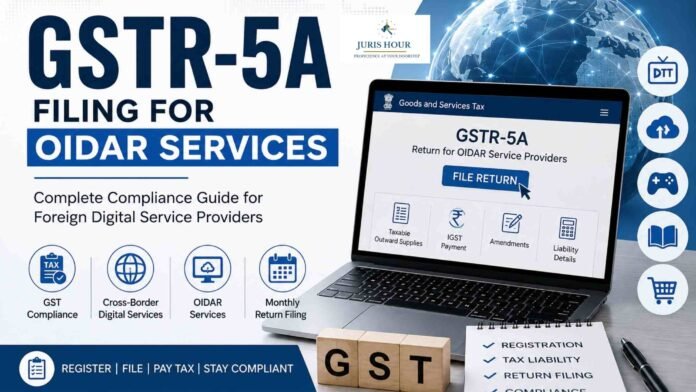
The rapid growth of cross-border digital services has significantly expanded the scope of GST compliance in India. Foreign companies providing online streaming, cloud computing, digital advertising, online gaming, SaaS platforms, e-books, database access, and other internet-based services to Indian consumers are now covered under the GST framework through the Online Information and Database Access or Retrieval (OIDAR) provisions.
To ensure taxation of such digital supplies, the GST law mandates filing of Form GSTR-5A by non-resident OIDAR service providers supplying services to non-taxable online recipients in India. The return serves as the principal compliance mechanism for foreign digital service providers operating in the Indian market without physical presence.
What Are OIDAR Services?
OIDAR refers to services delivered through the internet or electronic networks where the supply is essentially automated, involves minimal human intervention, and cannot be ensured without information technology.
Under GST, OIDAR services generally include:
- Online advertising services
- Cloud computing services
- Streaming platforms for movies, music, and OTT content
- E-books and digital publications
- Software downloads and SaaS subscriptions
- Website hosting services
- Online gaming platforms
- Database access and retrieval services
- Online data storage services
- Digital content subscriptions
The key feature of OIDAR services is that the entire transaction — supply, delivery, and consumption — occurs electronically.
Legal Framework Governing OIDAR Under GST
OIDAR taxation in India is governed primarily by:
- Integrated Goods and Services Tax Act, 2017 (IGST Act)
- CGST Rules relating to registration and return filing
- Provisions dealing with cross-border digital services
The GST regime was designed to create parity between domestic digital service providers and foreign online platforms supplying services to Indian consumers.
Who Is Required to File GSTR-5A?
Form GSTR-5A is required to be filed by every non-resident OIDAR service provider supplying online services from outside India to:
- Unregistered persons in India
- Government entities
- Local authorities
- Other non-taxable online recipients
The filing requirement applies only where the recipient is not registered under GST and the service is not received for business purposes.
Examples of Entities Required to File GSTR-5A
Foreign providers such as:
- Streaming platforms
- Global cloud service providers
- Foreign software subscription companies
- International digital gaming companies
- Online learning platforms
- Foreign digital advertising providers
may be required to file GSTR-5A if they supply services directly to Indian consumers.
When Is GSTR-5A Not Applicable?
GSTR-5A is generally not applicable where OIDAR services are supplied to registered persons in India.
In such cases, GST liability is usually discharged by the Indian recipient under the Reverse Charge Mechanism (RCM).
Thus, the distinction between registered and unregistered recipients becomes extremely important for determining compliance responsibility.
Difference Between GSTR-5 and GSTR-5A
Many taxpayers confuse GSTR-5 with GSTR-5A. However, both returns apply to different categories of taxpayers.
| Basis | GSTR-5 | GSTR-5A |
| Applicable To | Non-resident taxable persons | Non-resident OIDAR service providers |
| Nature of Supply | Goods/services supplied temporarily in India | Online digital services supplied from outside India |
| Filing Frequency | Monthly | Monthly |
| Recipient Category | General taxable supplies | Mainly unregistered online recipients |
| Coverage | Broader business supplies | Cross-border digital services |
Registration Requirement for OIDAR Service Providers
A foreign OIDAR supplier must obtain GST registration before supplying taxable services to Indian consumers.
Without GST registration:
- GSTIN cannot be generated
- GSTR-5A cannot be filed
- Tax payment cannot be made lawfully
The GST law also permits appointment of a representative in India for compliance purposes.
Due Date for Filing GSTR-5A
GSTR-5A is a monthly return.
The due date for filing is the 20th day of the succeeding month.
Example
| Tax Period | Due Date |
| April 2026 | 20 May 2026 |
| May 2026 | 20 June 2026 |
| June 2026 | 20 July 2026 |
The return must be filed even if no supplies were made during the month.
Is NIL GSTR-5A Mandatory?
Yes.
Even where no business activity or taxable supply occurs during a tax period, NIL GSTR-5A filing remains mandatory.
Failure to file NIL returns can still attract late fees and compliance consequences.
Information Required for Filing GSTR-5A
The return captures details relating to taxable outward supplies made to Indian consumers.
Key details generally include:
- GSTIN of supplier
- Legal name and trade name
- Taxable outward supplies
- Amendments to previous returns
- Place of supply
- Taxable value
- Applicable IGST
- Interest liability
- Late fee liability
Major Tables in GSTR-5A
Table 1 – GSTIN
Auto-populated GST identification details of the OIDAR supplier.
Table 2 – Legal Name and Trade Name
Displays registered legal and trade names.
Taxable Outward Supplies
Contains details of digital services supplied to Indian consumers along with:
- Place of supply
- Rate of tax
- Taxable value
- IGST payable
Amendments Section
Used for corrections relating to previous tax periods.
Interest and Late Fee Table
Captures delayed payment liabilities.
Step-by-Step Procedure to File GSTR-5A
Step 1: Login to GST Portal
Visit the GST portal and login using GSTIN credentials.
Step 2: Access Returns Dashboard
Navigate through:
Services → Returns → Returns Dashboard
Select:
- Financial Year
- Return Filing Period
Step 3: Select GSTR-5A
Choose “Prepare Online” under GSTR-5A.
Step 4: Enter Supply Details
Fill details of:
- Taxable outward supplies
- Amendments
- Tax liability
- Interest and late fees
Step 5: Preview Return
Generate preview to verify correctness.
Step 6: Pay Tax Liability
GST liability must be discharged before filing the return.
Step 7: File Using DSC/EVC
Submit using Digital Signature Certificate or Electronic Verification Code.
Step 8: ARN Generation
Upon successful filing, an ARN is generated confirming submission.
Modes of Filing GSTR-5A
The return can generally be prepared through:
- Online filing on GST portal
- Offline utility upload mechanism
However, online filing remains the preferred mode for most taxpayers.
Important Compliance Conditions
Filing of Previous Return Mandatory
A taxpayer cannot file the current month’s GSTR-5A without filing the previous period’s return.
No Input Tax Credit (ITC)
Input Tax Credit is generally not available in GSTR-5A.
Tax Payment Before Filing
Return filing is permitted only after payment of applicable tax and dues.
Mandatory Monthly Compliance
Monthly filing obligation exists irrespective of turnover or transaction volume.
Late Fee for Delay in Filing GSTR-5A
Failure to file GSTR-5A within the due date attracts late fees.
Generally reported late fees include:
| Nature of Return | Late Fee |
| Normal Return | ₹200 per day |
| NIL Return | ₹100 per day |
Interest may also apply on delayed payment of tax liability.
Common Compliance Challenges for OIDAR Providers
Determination of Recipient Status
One of the biggest issues is determining whether the recipient is:
- Registered under GST, or
- An unregistered consumer
This distinction determines whether reverse charge applies or supplier liability arises.
Place of Supply Determination
Correct identification of place of supply becomes critical for cross-border digital services.
Multiple Jurisdiction Compliance
Foreign digital platforms operating globally often face difficulty aligning Indian GST obligations with international tax systems.
Classification Issues
Disputes may arise regarding whether a service qualifies as OIDAR or involves substantial human intervention.
Practical Compliance Tips for Foreign Digital Service Providers
Maintain Strong Customer Identification Systems
Platforms should capture:
- Billing address
- IP address
- Payment instrument location
- GSTIN verification
to determine recipient status accurately.
Automate GST Collection
Digital platforms should integrate GST computation directly into subscription and payment systems.
Track Amendments Properly
Corrections relating to prior periods should be disclosed carefully through amendment tables.
Ensure Timely Filing
Automated compliance reminders should be maintained to avoid recurring penalties.
Importance of GSTR-5A in India’s Digital Tax Framework
GSTR-5A has become a crucial compliance mechanism for taxing cross-border digital services in the modern digital economy.
The return ensures that:
- Foreign digital suppliers contribute GST on Indian consumption
- Domestic suppliers are not placed at a competitive disadvantage
- Tax leakage from digital commerce is minimized
- Online service transactions remain traceable
With the rapid expansion of streaming platforms, SaaS businesses, AI-based subscription models, online gaming, and digital content ecosystems, GSTR-5A compliance is expected to become increasingly significant in India’s GST administration framework.
Conclusion
GSTR-5A is a specialized monthly GST return applicable to non-resident OIDAR service providers supplying digital services to unregistered persons in India. The compliance framework imposes mandatory registration, monthly filing, tax payment obligations, and strict reporting requirements even in NIL periods.
Foreign digital businesses operating in India must carefully evaluate:
- Whether their services qualify as OIDAR
- The GST status of Indian customers
- Place of supply rules
- Timely return filing obligations
As India’s digital economy continues to grow, regulatory scrutiny over cross-border online services is likely to intensify further, making robust GSTR-5A compliance systems indispensable for international digital service providers.

