
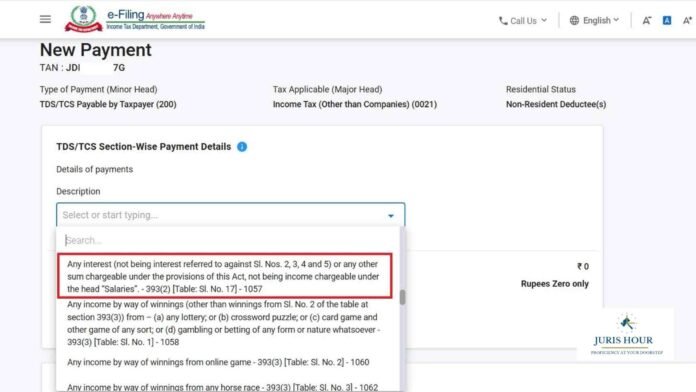
In recent days, a significant degree of confusion has emerged among tax professionals and taxpayers regarding the procedure for depositing Tax Deducted at Source (TDS) on payments made to non-residents for the purchase of immovable property, particularly in light of the changes introduced under the Finance Act 2026 and the new Income-tax Act 2026.
The uncertainty appears to stem from a misunderstanding of the effective date of certain amendments, especially those relating to the introduction of a PAN-based TDS payment mechanism.
Existing TAN-Based System Continues Till 30.09.2026
As per the current legal position, TDS payments involving non-resident deductees must continue to be made through the Tax Deduction and Collection Account Number (TAN) login. This process remains unchanged and is consistent with the procedure followed under the earlier regime.
For such transactions, the applicable section code under the new framework is Code 1057, which pertains to “interest or other sums chargeable to tax (other than salary).” Tax deductors are required to select this code while making TDS payments through the prescribed challan.
PAN-Based Payment Mechanism Yet to Come into Force
Although the Finance Act 2026 introduces a shift towards a PAN-based TDS payment system, it is crucial to note that this amendment is not immediately effective. The new mechanism will come into force only from 01 October 2026.
Accordingly, until 30 September 2026, the existing TAN-based compliance framework will continue to remain valid, and no transition to the PAN-based system is required at this stage.
Misinterpretation of Amendments Leading to Confusion
The confusion being witnessed appears to be largely due to partial reading of statutory amendments and premature assumptions that the newly introduced PAN-based mechanism has already replaced the existing system. In reality, such changes often have deferred implementation dates, allowing time for system readiness and stakeholder transition.
Advisory to Taxpayers and Professionals
Taxpayers and professionals are advised to exercise caution before acting upon unverified information, especially content circulated through social media or informal channels. It is essential to carefully examine the effective dates of legislative amendments, as announcements and enactments do not necessarily coincide with their operational commencement.
Until further notification or the notified date of implementation, the existing procedural requirements under the Income-tax law continue to govern TDS compliance in respect of non-resident transactions.

