
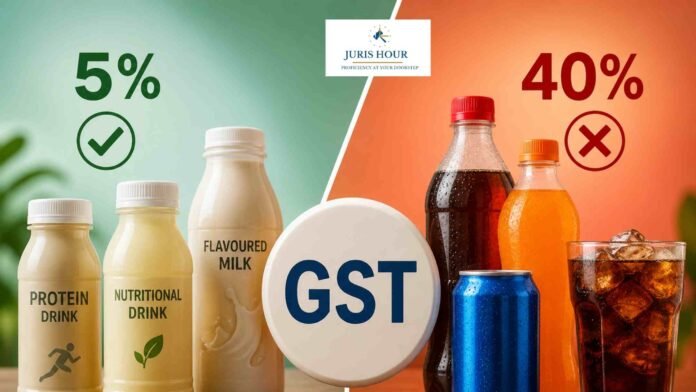
The Central Government has issued fresh amendments clarifying the tax treatment of beverages by rationalising tariff entries under the 5% and 40% slabs.
The notification clearly distinguishes between nutritional and milk-based drinks attracting lower tax and aerated or sugar-sweetened beverages falling under the higher tax bracket, with effect from May 1, 2026.
As earlier reported, the government has substituted tariff entries under Schedule I (5%) and Schedule III (40%). However, a closer examination of the Customs Tariff reveals the nature of goods impacted by these changes, providing clarity on their tax treatment.
5% GST Slab: Nutritional and Milk-Based Beverages Covered
Under Schedule I (5%), the substituted tariff items—2202 99 21, 2202 99 29, 2202 99 31, and 2202 99 39—primarily relate to nutritional and milk-based beverages.
These typically include:
- Milk-based drinks, including flavoured milk
- Protein-based or nutritional beverages
- Health drinks and dietary supplements in liquid form
- Beverages containing milk solids or dairy derivatives
Such products are generally positioned as nutritional or health-oriented drinks, often consumed as meal supplements or wellness beverages. The lower GST rate reflects their essential or semi-essential nature, especially when compared to carbonated or sugar-heavy beverages.
40% GST Slab: Aerated and Sugar-Sweetened Beverages
Under Schedule III (40%), the revised tariff entries—2202 99 90, 2202 99 91, and 2202 99 99—cover residual and high-tax category beverages, typically including:
- Aerated drinks and soft drinks (non-alcoholic)
- Sugar-sweetened beverages (SSBs)
- Energy drinks and carbonated beverages
- Other beverages not specifically classified under concessional categories
These products are generally taxed at a higher rate due to their classification as luxury or sin goods, often accompanied by compensation cess in certain cases. The inclusion of these tariff codes under the 40% slab ensures that such beverages remain in the higher tax bracket.
Legislative Backing and Effective Date
The amendments have been issued under the powers conferred by Section 5 of the IGST Act, 2017 and Section 15(5) of the CGST Act, based on GST Council recommendations. Identical changes have been made under CGST and UTGST notifications to maintain uniformity across tax components.
The revised classification will come into effect from May 1, 2026.
Notification Details
Notification No. 01/2026-Integrated Tax (Rate)
Date: 30/04/2026
Read More: Service Tax Exemption on R&D Cess, CESTAT Quashes Demand and Extended Limitation in Panasonic Case

