
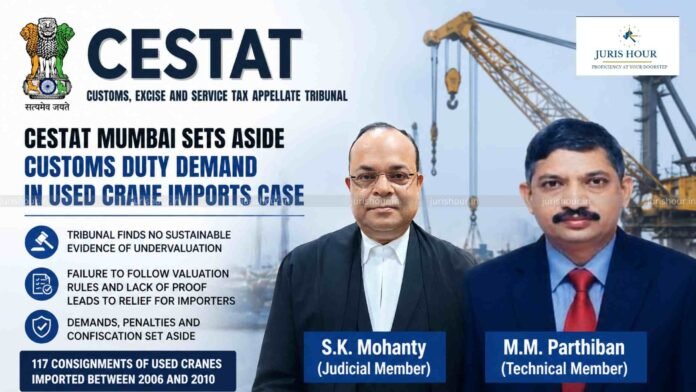
The Mumbai Bench of the Customs, Excise & Service Tax Appellate Tribunal (CESTAT) has set aside substantial customs duty demands, confiscation, and penalties in a long-running dispute involving the import of second-hand cranes.
The bench of S.K. Mohanty (Judicial Member) and M.M. Parthiban (Technical Member) has observed that the department failed to establish undervaluation with cogent evidence and could not re-determine the assessable value without properly displacing the earlier accepted valuation.
The appeals arose from an order passed by the Commissioner of Customs (Import-I), Mumbai, confirming differential duty of over ₹8.35 crore along with interest, imposing redemption fine, and levying multiple penalties against the importers. The case pertained to import of 117 consignments of used cranes and accessories between 2006 and 2010.
The imports were originally assessed on a “first check” basis, where goods were physically examined and valued with the assistance of independent Chartered Engineers, as per prevailing CBEC guidelines. The importers paid duty based on such assessments before clearance.
However, subsequent investigations by the Directorate of Revenue Intelligence (DRI) alleged a complex modus operandi involving undervaluation, manipulation of freight and insurance, fabrication of documents, and alleged hawala remittances. Based on these allegations, a show cause notice was issued in April 2013 seeking recovery of differential duty and imposition of penalties.
The Tribunal examined the legality of re-determination of value under the Customs Act, 1962 read with the Customs Valuation Rules, 2007, and identified multiple infirmities in the Department’s case.
Firstly, it held that once goods are assessed and cleared after proper examination and valuation by Customs authorities, such assessment attains finality unless validly reopened within the statutory framework. The Tribunal noted that there was no credible evidence such as parallel invoices or proof of extra consideration to justify rejection of the declared value.
Secondly, the Tribunal emphasized that valuation under the Customs Valuation Rules must follow a strict sequential framework. It found that the Department had resorted to Rule 8 and Rule 9 (residual methods) without adequately justifying rejection of transaction value under Rule 3 and Rule 12.
The Tribunal also rejected the Department’s reliance on internet prices and generalized industry estimates of crane value per ton, describing such methods as lacking legal basis and evidentiary support.
A crucial aspect of the ruling was the Tribunal’s disapproval of reliance on statements recorded during investigation without proper cross-examination. Except for one witness, none of the persons whose statements were relied upon appeared for cross-examination.
The Tribunal reiterated that statements cannot be treated as substantive evidence unless tested through cross-examination, especially when such statements form the backbone of allegations of undervaluation.
Further, it found no corroborative evidence showing that any additional consideration had been paid by the importers beyond the declared invoice value.
The Tribunal also ruled that demands relating to several consignments were barred by limitation. It held that duty demands beyond the statutory period of five years from the date of show cause notice cannot be sustained under Section 28 of the Customs Act.
Importantly, it rejected the Revenue’s attempt to adjust voluntary payments made by the importers against such time-barred demands, holding that such adjustment had no legal basis.
Given the failure to establish undervaluation and the absence of evidence of deliberate misdeclaration, the Tribunal held that confiscation under Section 111(m) and penalties under Sections 112, 114A, and 114AA of the Customs Act were not sustainable.
It reiterated that mere re-assessment or suspicion of undervaluation cannot automatically lead to penal consequences unless supported by clear evidence of intent to evade duty.
The Tribunal ultimately dismissed the Revenue’s appeals and granted relief to the importers, holding that the entire case of undervaluation was built on weak evidentiary footing and improper application of valuation rules.
Case Details
Case Title: Govindji Gopalji & Sons Versus Commissioner of Customs (Import-I)
Citation: JURISHOUR-1023-CES-2026(BOM)
Case No.: Customs Appeal No. 87475 Of 2024
Date: 28.04.2026
Counsel For Appellant: Deepak Sharma, Authorized Representative
Counsel For Respondent: Chirag Shetty a/w Ms. Ayushi Agarwal
Read More: No Service Tax Payable Where Turnover Below Rs. 10 Lakh Threshold: CESTAT

