
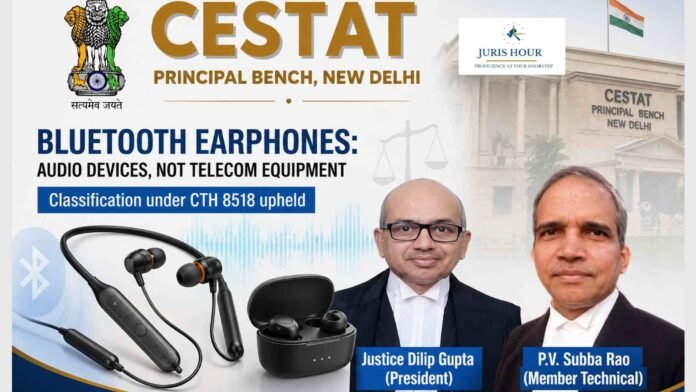
The New Delhi Bench of the Customs, Excise and Service Tax Appellate Tribunal (CESTAT) has held that Bluetooth wireless earphones, earbuds, and neckbands are classifiable under Customs Tariff Heading (CTH) 8518 as “headphones/earphones,” and not under CTH 8517 as telecommunication devices.
The bench of Justice Dilip Gupta (President) and P.V. Subba Rao (Technical Member) has ruled that the primary function of such devices is audio playback, and not transmission or reception of data for mobile telephony, thereby denying the benefit of concessional duty under Notification No. 57/2017.
The appeal was filed against an order of the Principal Commissioner of Customs, Air Cargo Complex (Import), New Delhi, which had reclassified imported Bluetooth audio devices and confirmed differential duty along with interest and penalty.
The importer had classified the goods under CTH 8517 62 90 as apparatus for transmission/reception of data and availed concessional 10% duty. The department, however, contended that the goods were more appropriately classifiable under CTH 8518 30 00, attracting 15% duty, as they are essentially audio output devices.
The Tribunal examined the nature, functionality, and usage of the products and emphasized that classification must be based on the primary function and objective characteristics of the goods at the time of import, rather than incidental features like Bluetooth connectivity.
Upholding the department’s classification, the Tribunal observed that the dominant function of Bluetooth earphones is audio playback from connected devices such as mobile phones, laptops, and televisions. Features like calling and voice transmission are secondary and become operational only when paired with a mobile phone. Product literature and brochures highlight sound quality and listening experience as the key attributes, not telecommunication capabilities.
The Tribunal held that merely incorporating Bluetooth technology does not transform an audio device into a data transmission apparatus.
The Bench further noted that Heading 8518 specifically covers “headphones and earphones, whether or not combined with a microphone,” making it an eo nomine (name-based) classification. Therefore, once the goods fit squarely within this heading, there is no need to resort to broader functional classifications under Heading 8517.
Relying on principles laid down by the Supreme Court, the Tribunal held that a specific entry must prevail over a general one, and classification cannot be altered merely due to added technological features like wireless connectivity.
The appellant had relied on CBIC Circular No. 36/2013, which allows classification under CTH 8517 for Bluetooth headsets used in mobile telephony. However, the Tribunal clarified that the Circular applies only where the principal function is mobile communication.
Since the imported goods were multi-device compatible and not designed primarily for telephony, the Circular was held inapplicable.
The Tribunal distinguished earlier rulings such as Amazon Wholesale India, Minda D-Ten, and L.G. Electronics, noting that those cases involved devices with core functions of data processing, communication, or internet connectivity. In contrast, the present goods are passive audio output devices without independent data processing or transmission capability.
On the issue of limitation, the Tribunal delivered significant relief to the appellant. It held that the dispute was purely interpretational, relating to classification. There was no evidence of suppression of facts or intent to evade duty. Therefore, invocation of the extended period under Section 28(4) of the Customs Act was not justified.
Accordingly, the demand was restricted to the normal limitation period, and the extended demand was set aside.
Since penalty under Section 114A is contingent upon the same grounds as extended limitation, the Tribunal ruled that penalty cannot survive in absence of suppression or intent to evade, and accordingly set it aside.
The Tribunal partly allowed the appeal, holding that classification under CTH 8518 30 00 is correct; demand is sustainable only for the normal period; extended period demand and penalty are set aside; and matters remanded for quantification of duty and interest for the normal period.
Case Details
Case Title: M/s G-Mobile Devices Pvt. Ltd. Versus Principal Commissioner of Customs
Citation: JURISHOUR-1021-CES-2026(DEL)
Case No.: CUSTOMS APPEAL NO. 50651 OF 2025
Date: 29.04.2026
Counsel For Appellant: Tarun Gulati, Senior Advocate
Counsel For Respondent: Ranjan Prakash and Shri Nikhil Mohan Goyal, Authorised Representative
Read More: Penalty U/s 26 of Central Excise Rules Unsustainable Without Finding on Confiscation: CESTAT

