
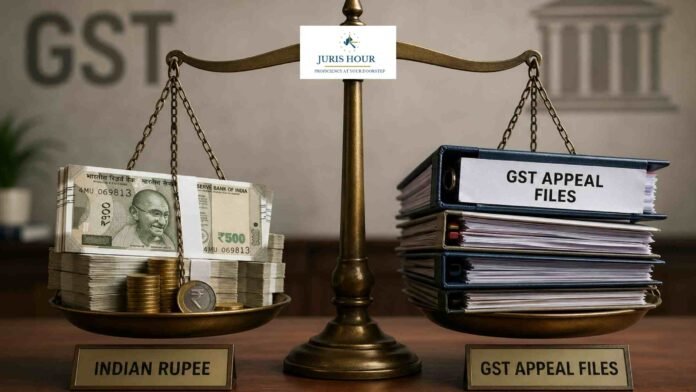
The government has formally fixed monetary thresholds for departmental appeals, providing that tax authorities will not file appeals where the disputed amount is below Rs. 20 lakh before the GST Appellate Tribunal (GSTAT), Rs. 1 crore before High Courts, and Rs. 2 crore before the Supreme Court.
These limits have been notified through Circular No. 207/1/2024-GST dated June 26, 2024, with the objective of reducing unnecessary litigation and ensuring that only significant revenue matters are pursued.
The circular derives its legal backing from the Central Goods and Services Tax Act, 2017, particularly Section 120, which empowers the government to prescribe monetary limits for filing appeals. It also clarifies an important legal position: non-filing of an appeal due to these thresholds will not be treated as acceptance of the decision by the department, thereby safeguarding the revenue’s position in future disputes on similar issues.
As per the circular, clear limits have been laid down for different appellate forums. Departmental appeals will not be filed before the GSTAT where the disputed amount is below ₹20 lakh, before High Courts where it is below ₹1 crore, and before the Supreme Court where it is below ₹2 crore. These thresholds apply to appeals, applications, and Special Leave Petitions, subject to certain specified exceptions.
The circular also provides detailed guidance on how the “amount in dispute” is to be calculated. In cases involving tax demand, only the tax component is to be considered, excluding interest and penalty. Where disputes relate solely to interest, penalty, or late fee, the respective amount will be considered. In refund-related matters, the disputed refund amount becomes relevant. Further, in cases involving composite orders covering multiple issues, the total disputed amount is to be taken into account rather than examining each issue separately.
Buy Now: 500+ CGST Notifications (2017–2025) | Clickable Index E-Magazine | Hyperlinked Original PDFs
However, the monetary limits are not absolute. The circular carves out important exceptions where appeals may still be filed irrespective of the amount involved. These include cases involving constitutional validity of GST provisions, challenges to rules or notifications, and matters relating to classification, valuation, refunds, or place of supply that are recurring in nature or involve significant interpretation of law. Appeals may also be filed where adverse remarks or costs have been imposed against the department, or where the Board considers it necessary in the interest of justice or revenue.
Importantly, the circular emphasizes that merely exceeding the prescribed monetary limit does not automatically warrant filing an appeal. Officers are required to examine each case on its merits and take a considered decision, keeping in mind the broader objective of reducing avoidable litigation and promoting certainty for taxpayers.
Another key clarification is that cases where appeals are not filed due to low tax effect will not carry any precedent value. Taxpayers cannot claim that the department has accepted a legal position simply because no appeal was filed. Authorities are required to explicitly record that the appeal is not being filed due to the monetary limit, and departmental representatives must inform courts accordingly to avoid any adverse inference.
The move is aligned with the government’s broader policy to reduce litigation and improve efficiency in tax administration. By setting clear thresholds and guidelines, the circular is expected to significantly reduce the volume of routine appeals, allowing authorities and courts to focus on high-value and legally important matters.
Overall, the notification of monetary limits under GST marks a crucial step towards a more streamlined and balanced dispute resolution framework, benefiting both taxpayers and the administration while strengthening the efficiency of the indirect tax system.

