
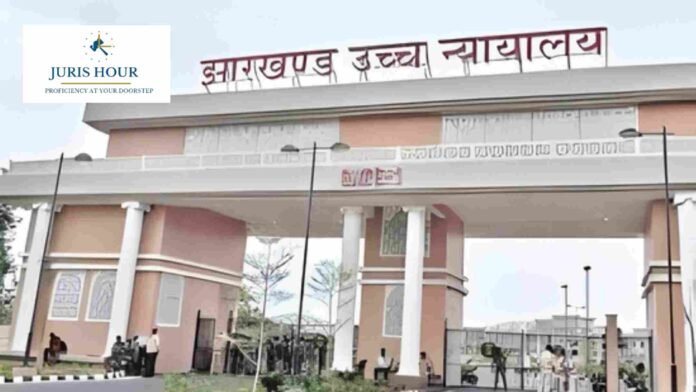
The Jharkhand High Court has dismissed a criminal miscellaneous petition filed by Dilip Kumar Ghosh seeking quashing of money laundering proceedings under the Prevention of Money Laundering Act, 2002 (PMLA), holding that such a petition—filed belatedly and challenging multiple judicial orders together—is not maintainable.
The bench of Justice Sujit Narayan Prasad has observed that multiple distinct judicial orders—such as cognizance, rejection of discharge, and framing of charges—cannot be challenged through a single “rolled-up” petition. Each order constitutes a separate cause of action and must be challenged independently through appropriate legal remedies. The petitioner failed to file revision petitions within the prescribed 90-day limitation period and instead approached the High Court after significant delay. The trial had already progressed substantially, with witnesses examined, and the petitioner had actively participated in the proceedings.
The petition was filed under Section 528 of the Bharatiya Nagarik Suraksha Sanhita, 2023 (BNSS), corresponding to Section 482 of the CrPC, seeking quashing of the entire criminal proceedings arising out of an Enforcement Directorate (ED) complaint, including the cognizance order, rejection of discharge application, and the order framing charges.
The matter stems from an ECIR registered by the Directorate of Enforcement based on an FIR alleging forgery and cheating in relation to a property transaction in Ranchi. The allegations included use of forged documents such as Aadhaar, electricity bills, and possession letters to obtain municipal holding numbers and subsequently transfer property at a significantly undervalued rate.
The property, allegedly valued at over ₹20.75 crore as per government guidelines, was sold for ₹7 crore to a company represented by the petitioner, raising suspicion of money laundering under Section 3 of the PMLA.
Following investigation, the ED filed a prosecution complaint against multiple accused persons. The Special PMLA Court took cognizance, rejected the discharge application, and framed charges. The trial had already commenced, with several witnesses examined.
The central issue before the High Court was whether a composite petition under inherent jurisdiction (Section 528 BNSS / Section 482 CrPC) could be maintained to challenge multiple judicial orders passed at different stages of a criminal trial, especially when statutory remedies were not availed within limitation.
The High Court emphasized that inherent powers of the Court are extraordinary and must be exercised sparingly. It held that such powers cannot be used to bypass statutory remedies like revision, particularly when those remedies have become time-barred.
The Court held that invoking inherent jurisdiction at such a stage would amount to abuse of process and an attempt to circumvent procedural law.
The petitioner had alternatively sought permission to convert the petition into a revision application. However, the Court noted that the petition was filed beyond the limitation period for revision. No application for condonation of delay was filed. The petition involved multiple prayers, which could not be accommodated within a single revision proceeding.
Holding that the petition was a belated attempt to bypass statutory remedies and disrupt an ongoing trial, the Court dismissed the plea as not maintainable. It reiterated that inherent jurisdiction cannot be used as a substitute for remedies expressly provided under procedural law, especially when the trial has already advanced.
Case Details
Case Title: Dilip Kumar Ghosh Versus UOI
Citation: JURISHOUR-984-HC-2026(JHAR)
Case No.: Cr.M.P. No.1861 of 2025
Date: 24/04/2026
Counsel For Petitioner: S. Nagamuthu, Sr. Advocate
Counsel For Respondent: Amit Kr. Das, Advocate
Read More: Ex IAS Anil Tuteja Denied Bail in PMLA-Linked Corruption Case: Chhattisgarh High Court

