
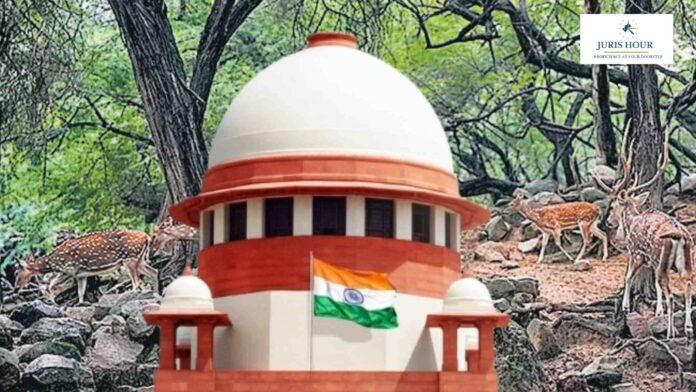
The Supreme Court of India has upheld the decision to translocate surplus deer from A.N. Jha Deer Park, Hauz Khas, New Delhi, to ecologically suitable tiger reserves, while emphasizing strict adherence to scientific guidelines and animal welfare norms.
The bench of Justice Vikram Nath and Justice Sandeep Mehta has directed the Ministry of Environment, Forest and Climate Change to examine and implement comprehensive national guidelines on wildlife translocation within six months, granting them statutory backing. These guidelines aim to standardize conservation practices across India in line with international norms such as those of the IUCN.
The case arose from concerns over the large-scale translocation of deer from the park to reserves in Rajasthan and within Delhi. The petitioner challenged the move, arguing that relocation could endanger the animals and that expansion of habitat within the park should be explored instead. However, the Court, relying on expert findings and statutory considerations, found the translocation policy to be justified and necessary.
At the core of the judgment is a detailed report submitted by the Central Empowered Committee (CEC), which highlighted that the deer population at the park had grown beyond sustainable limits. Based on Central Zoo Authority (CZA) guidelines, the park’s carrying capacity was assessed at only 38 deer, far below the existing population. The Court noted that overcrowding, coupled with inadequate infrastructure and absence of population control measures, necessitated scientific intervention.
The Court further observed that the park had lost its recognition as a “mini zoo” due to non-compliance with statutory norms and expiry of its licence. In such circumstances, continued retention of a large deer population without proper regulatory oversight was held to be impermissible in law.
Buy Now: E-Compilation of Supreme Court Judgements – March 2026
Rejecting the petitioner’s plea for intra-park or intra-city relocation, the Court accepted the CEC’s conclusion that such measures would merely shift the problem without resolving underlying ecological and management issues. Instead, scientifically managed translocation to suitable wild habitats was deemed a sustainable and ecologically sound solution.
The Court also flagged deficiencies in earlier translocation efforts, noting that some deer had been relocated in a manner that was “unduly harsh” and inconsistent with established wildlife protocols. The judgment underscores that animals raised in controlled environments require gradual acclimatization and structured release strategies to ensure survival and ecological integration.
The Court has accepted all recommendations of the CEC and directed authorities to carry out future translocation in a phased, time-bound manner under expert supervision. It mandated compliance with detailed guidelines covering identification, tagging, transportation, veterinary care, habitat assessment, and post-release monitoring. The Court also emphasized the use of “soft release” protocols and deployment of telemetry collars to track survival and adaptation of relocated deer.
While permitting retention of up to 38 deer at A.N. Jha Deer Park, the Court made it conditional upon obtaining approval from the Central Zoo Authority and ensuring adequate infrastructure, trained manpower, and compliance with prescribed standards. Failure to meet these conditions would require further directions from the Court.
The Court also reinforced the protected status of A.N. Jha Deer Park, directing that its ecological character as a protected forest must not be altered under any circumstances.
Case Details
Case Title: New Delhi Nature Society Versus Director Horticulture DDA
Citation: JURISHOUR-977-SC-2026
Case No.: SPECIAL LEAVE PETITION (CIVIL) NO(S). 13374-13375 OF 2025
Date: 27/04/2026

