
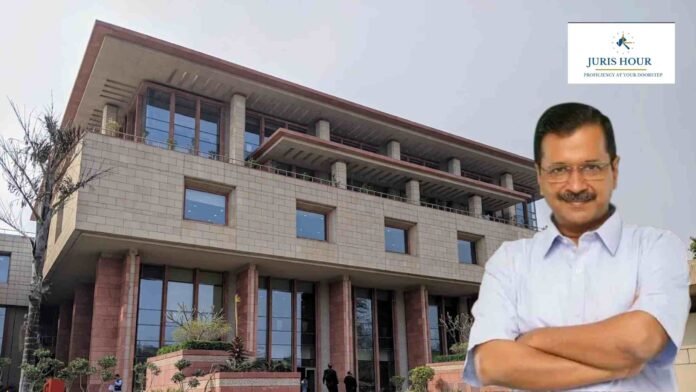
The Delhi High Court has rejected multiple recusal applications filed by accused persons, Arvind Kejriwal and Manish Sisodia in a high-profile criminal revision petition arising out of the alleged excise policy case investigated by the Central Bureau of Investigation (CBI) and held that a litigant’s mere apprehension of bias, without substantive legal foundation, cannot be a ground to seek recusal of a judge.
The bench of Justice Swarana Kanta Sharma, came in a revision petition filed by the CBI challenging the discharge of several accused persons, including prominent political figures such as Arvind Kejriwal and Manish Sisodia.
The controversy arose after the trial court discharged multiple accused in the excise policy case. The CBI challenged this discharge before the Delhi High Court. During the proceedings, several respondents moved applications seeking recusal of the presiding judge, alleging a reasonable apprehension of bias.
Buy Now: E-Compilation on Service Tax | February 2026 Edition
The applicants argued that earlier observations made by the Court in related proceedings, interim orders passed at the initial stage, and certain procedural aspects gave rise to a perception that they may not receive a fair hearing.
Rejecting these arguments, the High Court emphasized that the legal standard for recusal is not subjective discomfort or perception, but a reasonable and legally sustainable apprehension of bias.
The Court observed that a judge cannot be asked to step aside merely because a litigant feels uneasy or perceives bias. Judicial decisions often involve prima facie observations at interim stages, which are tentative and not final conclusions. Accepting such recusal pleas would allow litigants to indirectly choose benches, undermining judicial independence.
The Court categorically held that “mere apprehension in the mind of a litigant cannot be a ground for recusal”, especially when such apprehension is based on misunderstanding of judicial processes.
One of the key grounds raised by the applicants was that the Court had made adverse prima facie observations in an earlier order dated March 9, 2026.
The High Court clarified that prima facie observations are a routine judicial exercise while issuing notice or granting interim relief. Such observations are not binding findings and may change after full hearing. Treating them as final conclusions reflects a misinterpretation of law.
The Court warned that if such arguments were accepted, courts would be unable to grant interim relief or pass reasoned orders at the preliminary stage.
Importantly, the Court noted that the trial court’s discharge order was never stayed. The accused continue to remain discharged during pendency of proceedings. Interim protection granted related only to remarks against the Investigating Officer, not against the accused.
Thus, the Court found no actual prejudice caused to the applicants.
The court cautioned that allowing recusal on such grounds would encourage forum shopping, undermine judicial discipline and disrupt the administration of justice.
The Court reiterated that the proper remedy against an adverse order is to challenge it before a higher court, not seek recusal.
The Court underscored that judicial integrity cannot be put on trial based on speculative allegations. It stressed that judges must decide cases fearlessly and independently, without succumbing to pressure from litigants.
The Delhi High Court’s ruling reaffirms a crucial principle of judicial functioning: recusal cannot be sought as a matter of strategy or perception.
Case Details
Case Title: CBI Versus Kuldeep Singh & Ors.
Citation: JURISHOUR-873-HC-2026(DEL)
Case No.: CRL.REV.P. 134/2026 & CRL.M.A. 6853/2026
Date: 20.04.2026
Counsel For Petitioner: Tushar Mehta, SG
Counsel For Respondent: Tushar Agarwal

