
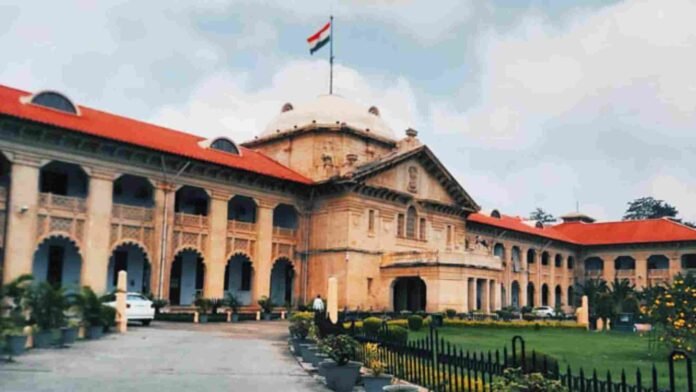
The Allahabad High Court has set aside a GST assessment order passed under Section 73 of the U.P. GST Act, holding that failure to provide an opportunity of personal hearing—despite issuance of a show cause notice—amounts to a clear violation of principles of natural justice.
The bench of Justice Vikas Budhwar has observed that the absence of any scheduled personal hearing in the notice itself demonstrated a fundamental procedural lapse. Relying on its earlier decision in M/s Anshika Associates, the Court reiterated that the requirement of written reply and oral hearing are independent safeguards under the law. Denial of one cannot be justified by the availability of the other.
BUY NOW: Ultimate Legal & Taxation Mega Combo Pack – March 2026 Edition
In the case of M/s Harpal Singh vs State of U.P. & Others, the petitioner, a registered dealer, challenged the validity of the adjudication proceedings initiated for the financial year 2018–19. The proceedings began with a notice in Form ASMT-10 dated October 20, 2023, which required the petitioner to submit a reply by November 20, 2023. However, the notice failed to specify the date, time, or venue for personal hearing, marking these fields as “NA.”
The petitioner contended that although a show cause notice under Section 73 was issued, neither the notice nor the subsequent order was served through email or registered mobile number. Eventually, an ex parte order was passed on April 29, 2024. The petitioner claimed to have gained knowledge of this order only in November 2025, following which an appeal was filed. However, the appellate authority rejected the appeal on grounds of limitation without examining the merits.
Before the High Court, the petitioner argued that the entire adjudication process was flawed as it violated Section 75(4) of the GST Act, which mandates granting an opportunity of personal hearing where an adverse decision is contemplated. It was emphasized that merely calling for a written reply does not substitute the statutory requirement of oral hearing.
The Court further noted that there was no material to show that the petitioner had waived the right to personal hearing. In such circumstances, the adjudication order passed without affording such an opportunity could not be sustained.
Taking into account the overall facts, including delayed knowledge of the order and summary rejection of the appeal, the Court held that both the original adjudication order and the appellate orders were liable to be set aside.
Accordingly, the High Court quashed the assessment order dated April 29, 2024, as well as the appellate orders dated December 1, 2025, and January 5, 2026. The matter has been remanded back to the adjudicating authority with directions to issue a fresh show cause notice specifying the date, time, and venue of personal hearing, and to pass a reasoned order after granting due opportunity to the petitioner.
The Court also directed that the fresh proceedings be concluded within three months and clarified that it had not expressed any opinion on the merits of the case.
Case Details
Case Title: M/S Harpal Singh Versus State Of U.P. And 2 Others
Citation: JURISHOUR-845-HC-2026(ALL)
Case No.: Writ Tax No. – 333 Of 2026
Date: 06/04/2026
Counsel For Petitioner: Pooja Talwar
Counsel For Respondent: C.S.C.
Read More: Demand Cannot Exceed SCN: Allahabad High Court Quashes GST Demand Against MakeMyTrip

