
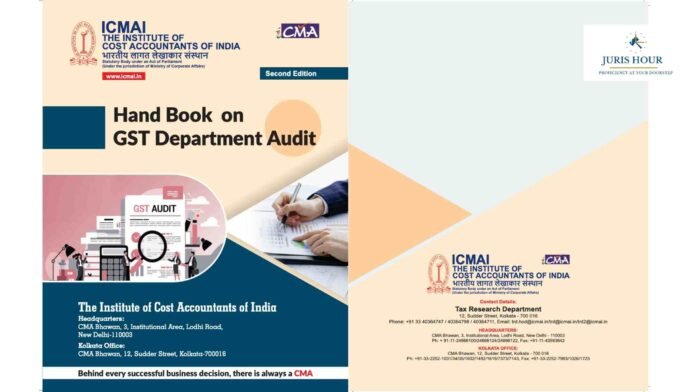
The Institute of Cost Accountants of India (ICMAI) has released the second edition of its Handbook on GST Department Audit, positioning departmental audits as a central pillar in ensuring compliance, transparency, and revenue protection under the Goods and Services Tax (GST) regime.
The handbook highlights how GST audits in India have evolved from traditional verification exercises into data-driven, analytical processes aimed at strengthening voluntary compliance and improving systemic efficiency. It notes that with GST’s digital framework, every transaction is electronically recorded, enabling authorities to rely heavily on analytics, risk profiling, and cross-verification mechanisms during audits.
According to the publication, departmental audits are no longer limited to identifying errors but are increasingly focused on fostering trust between taxpayers and authorities. The audit framework is designed to ensure that taxpayers correctly declare turnover, input tax credit (ITC), refunds, and tax liabilities while also detecting discrepancies and preventing revenue leakages.
The handbook explains that GST audits are primarily conducted under Sections 65 and 66 of the CGST Act. A general audit may be undertaken by tax authorities based on risk parameters, while special audits are initiated in complex or high-risk cases and conducted by Chartered Accountants or Cost Accountants. These audits involve a detailed examination of financial records, GST returns, and supporting documents to assess compliance with the law.
A key feature emphasized is the shift toward risk-based selection of cases. Taxpayers are flagged for audit based on indicators such as mismatches between GSTR-1 and GSTR-3B, abnormal ITC claims, unusual turnover patterns, or sector-specific risks. Advanced tools, including business intelligence systems and GSTN data analytics, are now widely used to identify such high-risk cases.
The audit process itself follows a structured approach, beginning with case selection and desk review, followed by field verification and post-audit reporting. Tax authorities are required to issue prior notice in Form GST ADT-01 and complete general audits within three months, extendable by six months. Findings are communicated through Form GST ADT-02, ensuring transparency and giving taxpayers an opportunity to respond before any recovery action is initiated.
Importantly, the handbook underscores that GST audits serve broader objectives beyond enforcement. These include promoting taxpayer education, encouraging proper record-keeping, and enabling voluntary compliance. Audits also play a crucial role in detecting fraud such as fake invoicing, circular trading, and misclassification of goods or services.
The publication further stresses the principles of fairness, accountability, and transparency in audit proceedings. Taxpayers are entitled to prior notice, access to audit findings, and the right to be heard before any adverse action is taken. At the same time, authorities are expected to adhere to timelines, rely on evidence-based findings, and avoid unnecessary disruption to business operations.
Read More: Delhi Court Grants ED Custodial Remand in ₹11,500+ Crore RHFL–RCFL Money Laundering Probe

