
GST search proceedings often create an atmosphere of anxiety and pressure for taxpayers.
The presence of enforcement officers, seizure of documents, and questioning can lead to situations where taxpayers may feel compelled to comply with demands without fully understanding their legal rights.
However, both statutory provisions and judicial precedents have evolved to ensure that such powers are not exercised arbitrarily. Over time, courts have repeatedly emphasized that while the department has the authority to investigate tax evasion, such powers must be exercised within the boundaries of law, fairness, and procedural safeguards.
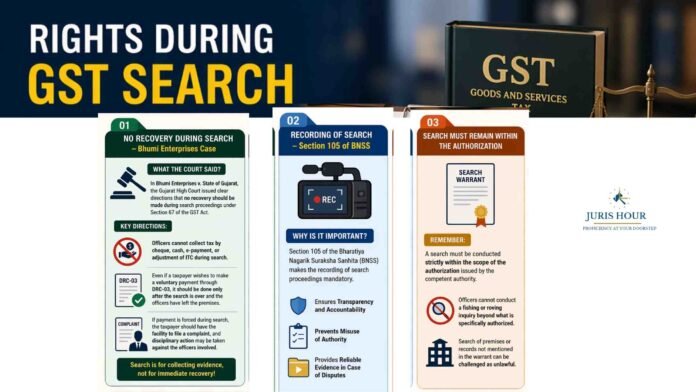
Among the most significant protections available to taxpayers are: the prohibition on recovery during search proceedings, the requirement of recording searches to ensure transparency, and the restriction that searches must remain strictly within the scope of authorization. These safeguards are not merely technical requirements but form the backbone of protecting taxpayers from coercive practices and abuse of power.
This article examines in detail three crucial rights that every taxpayer must be aware of during GST search proceedings.
BUY NOW: GST Searches: Case Laws In Favour And Against the Department (Updated Till January 2026)
Legal Framework Governing GST Search
Search and seizure under the Goods and Services Tax law are governed by Section 67 of the Central Goods and Services Tax Act, 2017. This provision empowers authorized officers to conduct searches where they have “reasons to believe” that a taxpayer has suppressed transactions, claimed excess input tax credit, or engaged in activities that may result in tax evasion.
The law also allows seizure of goods, documents, books, and other relevant materials. However, such powers are not unfettered. They are subject to procedural safeguards, constitutional principles, and judicial oversight. Courts have consistently held that enforcement actions must comply with principles of natural justice and must not result in coercion or forced recovery.
No Recovery During Search: A Critical Safeguard
One of the most important protections available to taxpayers during GST search proceedings is the prohibition against recovery of tax during the course of the search itself.
This principle was strongly reinforced in the landmark judgment of the Gujarat High Court in Bhumi Enterprises v. State of Gujarat. The Court took note of widespread complaints where taxpayers were allegedly compelled to make payments during search operations, often under pressure or fear of further consequences.
The High Court issued clear and categorical directions to curb such practices. It held that during the course of a search under Section 67, officers are not permitted to recover tax in any form. This includes recovery through cash, cheque, electronic payment, or even adjustment of input tax credit. The Court recognized that the environment of a search is inherently coercive, and any payment made in such circumstances cannot be treated as truly voluntary.
Significantly, the Court clarified that even if a taxpayer wishes to make a voluntary payment using Form DRC-03, such payment should not be accepted during the search proceedings. Instead, the taxpayer should be allowed to make such payment only after the search has concluded and the officers have left the premises. This ensures that the element of coercion is eliminated and that any payment made is genuinely voluntary.
The judgment further emphasized accountability by directing that if any officer is found to have forced recovery during search proceedings, the taxpayer should be provided with a mechanism to lodge a complaint. In such cases, disciplinary action may be initiated against the concerned officers.
This ruling has far-reaching implications. It reinforces the principle that search proceedings are meant for gathering evidence and not for immediate recovery. Recovery can only be undertaken through due process, including issuance of show cause notices, adjudication, and adherence to statutory timelines.
Importance of Voluntariness in Tax Payments
The concept of voluntariness is central to tax compliance. Courts have repeatedly held that payments made under coercion or pressure cannot be treated as voluntary. In the context of GST searches, the distinction becomes even more important because the presence of officers and the threat of seizure or arrest can create a psychologically intimidating environment.
By deferring voluntary payments until after the search is completed, the judiciary has sought to ensure that taxpayers are given a fair opportunity to assess their liability and make informed decisions. This approach also aligns with the broader principles of fairness and transparency embedded in tax administration.
Mandatory Recording of Search Proceedings
Another critical safeguard available to taxpayers is the requirement of recording search proceedings under Section 105 of the Bharatiya Nagarik Suraksha Sanhita (BNSS).
The introduction of this provision marks a significant step toward ensuring transparency and accountability in enforcement actions. Recording of search proceedings serves multiple purposes. It creates an objective record of what transpired during the search, including the conduct of officers, statements recorded, and materials seized.
This requirement acts as a deterrent against misuse of power. When officers are aware that their actions are being recorded, the likelihood of coercion, intimidation, or procedural irregularities is significantly reduced. It also provides valuable evidence in case of disputes or allegations of misconduct.
For taxpayers, recorded proceedings can serve as a critical safeguard in defending their rights. In cases where allegations are made regarding forced payments, improper questioning, or unauthorized seizure, the recorded footage can help establish the true sequence of events.
The move toward recording also reflects a broader shift in enforcement practices toward greater transparency and accountability. It aligns with global best practices and strengthens the credibility of the tax administration system.
Scope of Search Must Be Limited to Authorization
The third key safeguard relates to the scope of search proceedings. Under the GST law, a search can only be conducted based on a valid authorization issued by a competent authority. This authorization specifies the premises to be searched and the purpose of the search.
It is a settled legal principle that any search must remain strictly within the scope of the authorization. Officers cannot go beyond what is permitted in the search warrant. This means that they cannot conduct a fishing or roving inquiry in the hope of uncovering unrelated violations.
Courts have consistently held that the power of search is a serious intrusion into the privacy and business operations of a taxpayer. Therefore, it must be exercised with restraint and strictly in accordance with law. Any deviation from the authorized scope may render the search illegal and the evidence collected inadmissible.
For instance, if the authorization pertains to a specific set of transactions or a particular period, the officers cannot expand the search to cover unrelated matters without obtaining fresh authorization. Similarly, search of premises not mentioned in the warrant may also be challenged as unlawful.
This safeguard ensures that the investigative process remains focused and prevents arbitrary or excessive use of power.
Judicial Emphasis on ‘Reasons to Believe’
Underlying the authorization for search is the requirement that the officer must have “reasons to believe” that a violation of the GST law has occurred. This is not a mere formality but a substantive requirement that must be based on credible material.
Courts have repeatedly scrutinized the existence and validity of such reasons. They have held that vague or unsubstantiated allegations cannot justify a search. The reasons must be recorded and must demonstrate a rational connection between the material available and the belief formed by the officer.
This requirement acts as an additional safeguard against arbitrary searches and ensures that the power is exercised only in genuine cases of suspected evasion.
Balancing Enforcement and Rights
GST is a self-assessment-based tax regime, and effective enforcement is necessary to prevent evasion and protect revenue. At the same time, it is equally important to ensure that enforcement actions do not infringe upon the rights of taxpayers.
The safeguards discussed above reflect an attempt to strike this balance. While the department is empowered to conduct searches and seize evidence, it must do so in a manner that respects legal boundaries and procedural fairness.
The prohibition on recovery during search prevents coercion, the requirement of recording ensures transparency, and the limitation on scope prevents overreach. Together, these safeguards create a framework that promotes fairness and accountability.
Practical Implications for Taxpayers
Understanding these rights can make a significant difference in how taxpayers respond during search proceedings. Awareness helps in preventing unnecessary compliance under pressure and enables taxpayers to assert their rights confidently.
During a search, taxpayers should remain calm and cooperative but should also be mindful of their legal protections. If any attempt is made to recover tax during the search, they can rely on judicial precedents to resist such demands. Similarly, they can ensure that the search is conducted within the authorized scope and that all proceedings are properly recorded.
It is also advisable to maintain proper documentation and seek professional assistance where necessary. Legal counsel can play a crucial role in ensuring that the rights of the taxpayer are protected throughout the process.
Accountability of Officers
The safeguards discussed are not merely theoretical. Courts have emphasized that any violation of these principles may result in consequences for the officers involved. The direction in the Bhumi Enterprises case regarding disciplinary action is a clear indication that misuse of power will not be tolerated.
Such accountability mechanisms are essential for maintaining trust in the tax administration system. They also serve as a deterrent against arbitrary or coercive practices.
Conclusion
GST search proceedings are a powerful tool in the hands of the tax authorities, but they are not beyond the control of law. The judiciary has played a crucial role in defining the contours of these powers and ensuring that they are exercised in a fair and transparent manner.
The three safeguards discussed in this article—no recovery during search, mandatory recording of proceedings, and limitation of search to authorized scope—are fundamental rights that every taxpayer must be aware of. They provide a shield against coercion, ensure transparency, and prevent misuse of authority.
As GST enforcement continues to evolve, awareness of such rights becomes increasingly important. A well-informed taxpayer is better equipped to navigate the challenges of search proceedings and to ensure that the process remains within the bounds of law.
Ultimately, the objective of tax administration should not only be revenue collection but also the promotion of trust, fairness, and compliance. Respecting the rights of taxpayers is an essential step in achieving that goal.
Read More: GST Recovery Proceedings Can’t Survive Once Returns Filed and Dues Paid: Andhra Pradesh High Court

