
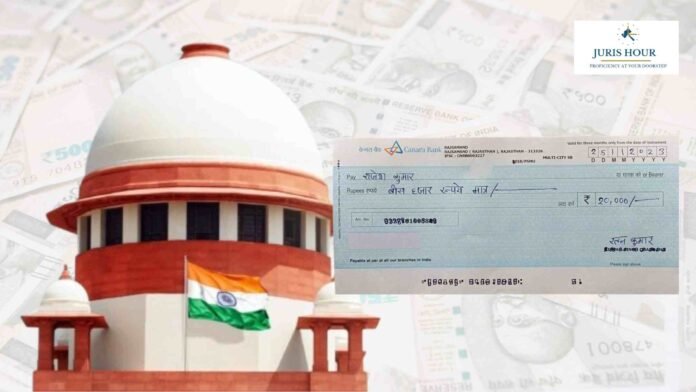
The Supreme Court has held that banks can be held liable for deficiency in service if they fail to present cheques within their validity period, leading to financial loss for customers.
However, the bench of Justice B.V. Nagarathna and Justice Ujjal Bhuyan has reduced the compensation awarded by the consumer forum from 10% to 6% of the cheque amount, terming the earlier award excessive.
The case arose from two cheques amounting to over ₹1.06 crore deposited by Kavita Chowdhary in her account with Canara Bank in May 2018. Although the cheques were initially credited, they were subsequently returned due to technical reasons and eventually became stale. The National Consumer Disputes Redressal Commission (NCDRC) found the bank guilty of deficiency in service and directed it to pay 10% of the cheque value along with interest and costs.
Before the Supreme Court, the bank argued that delays were caused by a nationwide bank strike and were therefore beyond its control under Section 75A of the Negotiable Instruments Act, 1881. It also contended that the complainant could still recover the amount from the drawer of the cheques. On the other hand, the respondent argued that the bank failed to re-present the cheques within the validity period despite having sufficient opportunity, thereby depriving her of legal remedies including action under Section 138 of the Negotiable Instruments Act.
The Supreme Court examined the factual matrix and noted that even if the initial delay was due to a bank strike, the bank failed to act promptly once operations resumed. The Court emphasized that there was no satisfactory explanation as to why the cheques were not re-presented on the next working days before their expiry. It held that a bank, acting as an agent of the customer, is under a duty to exercise due diligence in presenting cheques within their validity period.
Reinforcing the broad scope of “service” and “deficiency” under consumer protection law, the Court observed that failure to present cheques within time, resulting in their becoming stale, constitutes negligence and deficiency in service. It upheld the NCDRC’s finding on liability, stating that such findings were based on evidence and did not suffer from perversity.
However, on the issue of compensation, the Court took a more nuanced view. It noted that while the complainant lost the opportunity to initiate proceedings under Section 138 of the Negotiable Instruments Act, the outcome of such proceedings was uncertain. The Court held that compensation must be fair, reasonable, and proportionate to the actual loss suffered. Since the loss in this case was indeterminate, awarding 10% of the cheque value was considered excessive.
The Supreme Court reduced the compensation to 6% of the total cheque amount, along with interest at 6% per annum from the date of filing the complaint. This, the Court held, would meet the ends of justice while maintaining a balance between consumer rights and reasonable liability of service providers.
Case Details
Case Title: Canara Bank Versus Kavita Chowdhary
Citation: JURISHOUR-803-SC-2026
Case No.: Civil Appeal No. 2587 Of 2025
Date: 15/04/2026

