
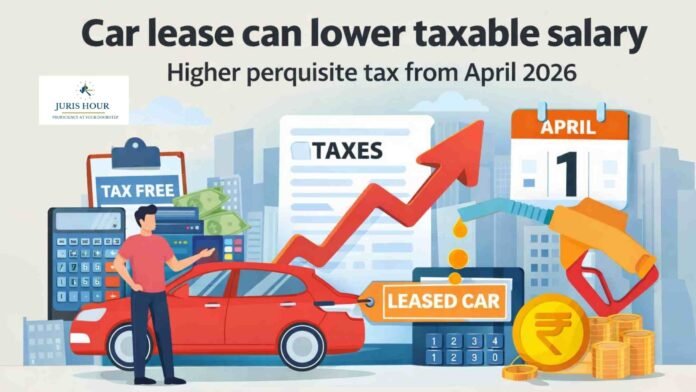
Car leasing continues to remain one of the last meaningful tax-saving avenues available to salaried employees under the new tax regime.
Structured as a salary component, a car lease allows employees to reduce their taxable income by converting a portion of their salary into lease rentals and reimbursements, thereby offering both convenience and tax efficiency. However, changes in perquisite taxation effective from April 1, 2026, are set to significantly alter the extent of these benefits.
Under a typical car lease structure, an employee opts for a company-leased vehicle where the employer pays the lease rental, fuel, and driver salary as part of the employee’s cost-to-company (CTC). These components are treated as tax-free up to a certain extent, thereby reducing the employee’s taxable salary. For instance, an employee in the 25% tax bracket paying ₹30,000 as lease rent and ₹15,000 towards fuel and driver salary can claim a monthly tax-free component of ₹45,000. On an annual basis, this translates to ₹5.4 lakh, resulting in a potential tax saving of ₹1.35 lakh.
In contrast, if the same employee purchases a car through a loan, only a limited portion—primarily reimbursements—qualifies for tax benefits, leading to significantly lower savings. As per the illustration, a buyer may achieve only ₹1.8 lakh in annual tax-free component, translating into tax savings of approximately ₹45,000. This makes leasing a far more tax-efficient option in the current regime.
Another advantage of the structure is that even car owners can claim fuel and driver salary reimbursements by submitting valid invoices, although the benefit remains more structured and optimized in a leasing arrangement.
However, the taxation of perquisites plays a crucial role in determining the actual benefit. When a leased car is used for both official and personal purposes, the Income Tax Rules prescribe a fixed perquisite value that is added back to the employee’s taxable income. Until FY 2025–26, this perquisite value remained relatively low. For vehicles up to 1.6 litres engine capacity or electric vehicles, the taxable perquisite was ₹32,400 annually, while for larger engines it was ₹39,600.
From April 1, 2026 onwards, this perquisite valuation is set to increase sharply. The annual taxable value will rise to ₹96,000 for cars up to 1.6 litres or EVs, and ₹1.2 lakh for vehicles with higher engine capacity. This change will significantly increase the taxable portion of the benefit, thereby reducing the net tax advantage of leasing.
Taking the earlier example, after factoring in the revised perquisite tax of ₹96,000, the effective annual tax-free component reduces from ₹5.4 lakh to ₹4.44 lakh. Consequently, the net tax savings fall to approximately ₹1.11 lakh. While this still represents a saving, the benefit is reduced compared to the earlier regime.
Despite the higher perquisite taxation, leasing continues to offer a relative advantage over outright purchase. Even after the adjustment, the employee in the example still saves about ₹66,000 more in taxes compared to not opting for a lease. Additionally, leasing provides non-tax benefits such as lower upfront costs, flexibility to upgrade vehicles, and reduced ownership burdens.
The upcoming changes indicate a policy shift aimed at rationalizing salary structuring benefits under the new tax regime. While the government has been gradually phasing out exemptions and deductions, car leasing remains one of the few structured options still available. However, with increased perquisite valuations, employees and employers may need to reassess the viability of such arrangements based on individual tax brackets and usage patterns.
In conclusion, car leasing continues to be a useful tax planning tool, but its attractiveness is likely to diminish post-April 2026 due to higher perquisite taxation. Taxpayers must carefully evaluate the cost-benefit equation, factoring in both tax savings and personal usage, before opting for such arrangements under the evolving tax framework.
Read More: 90% Late Fee Waiver Under CCFS-2026: MCA Opens 3-Month Window to Clear Backlog & Avoid Prosecution

