
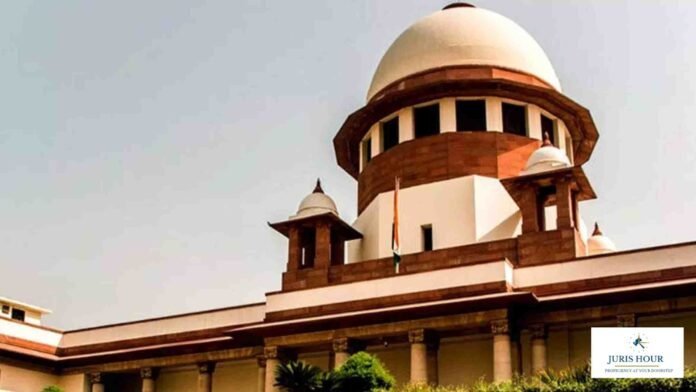
The Supreme Court has reaffirmed the necessity of strict adherence to eligibility conditions for reservation under the Economically Weaker Sections (EWS) category.
The bench of Justice Prashant Kumar Mishra and Justice N.V. Anjaria has dismissed multiple appeals challenging the rejection of candidates due to defective EWS certificates, holding that compliance with prescribed financial year requirements is mandatory.
The dispute arose from a recruitment drive conducted by the Uttar Pradesh Subordinate Services Selection Commission (UPSSSC) for 9,212 posts of Health Workers (Female), of which 10% were reserved for EWS candidates.
The advertisement, issued on December 15, 2021, required candidates to submit valid EWS certificates by the last date of application—January 5, 2022.
Several candidates who applied under the EWS category were later excluded from the selection list despite securing marks higher than the cut-off for EWS candidates. Their exclusion was based on discrepancies in the EWS certificates submitted.
The central question before the Court was whether EWS certificates that did not correspond to the correct financial year—or were issued before the close of the relevant financial year—could be accepted for claiming reservation benefits.
The Court held that for EWS reservation, the certificate must reflect income and assets for the financial year preceding the year of application—in this case, 2020–2021.
It observed that many candidates had submitted certificates: isued before the end of the relevant financial year, or pertaining to incorrect financial years (e.g., 2019–20 or 2021–22)
Such certificates were deemed fundamentally defective and invalid for claiming EWS reservation.
The Court emphasized that eligibility conditions tied to a specific financial year go to the root of candidature; certificates must strictly conform to the prescribed format and timeline; and any deviation renders the claim untenable
The appellants argued that errors in the certificates were attributable to issuing authorities and that candidates should not be penalized for administrative mistakes.
However, the Court rejected this contention, noting that most certificates were obtained before the advertisement was even issued, giving candidates sufficient opportunity to obtain correct certificates. Candidates bear responsibility for ensuring compliance with eligibility criteria
The bench also made broader observations on public recruitment, highlighting that online application systems process large volumes of data automatically, even minor errors in submitted documents can lead to rejection; and courts should be cautious in interfering with such rejections, as it may delay recruitment and affect thousands of candidates
Upholding the decision of the Allahabad High Court, the Supreme Court dismissed all appeals, concluding that the candidates failed to meet the eligibility criteria due to invalid EWS certificates.
Case Details
Case Title: Poonam Dwivedi & Ors. Versus State Of UP
Citation: JURISHOUR-722-SC-2026
Case No.: SLP (C) No.4001-4002 of 2023
Date: 10/04/2026

