
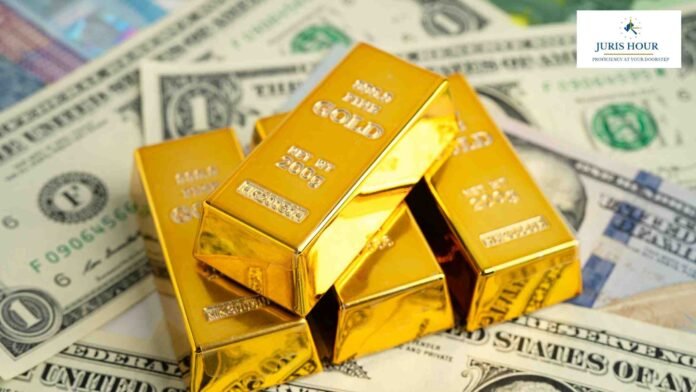
India’s gold imports witnessed a sharp rise of 28.73% to reach $69 billion during the April–February period of FY 2025–26, compared to $53.52 billion in the corresponding period of the previous fiscal, according to data released by the Commerce Ministry and reported by PTI. The increase has been largely attributed to elevated global and domestic prices of the precious metal, alongside sustained demand in the jewellery sector.
Rising Prices Drive Import Value
Gold prices in the domestic market have remained significantly high, currently hovering around ₹1,51,500 per 10 grams (inclusive of taxes) in the national capital. The surge in prices has amplified the overall import bill despite stable or moderately rising volumes, indicating that value-driven growth has been a key factor behind the spike.
Trade Deficit Widens Sharply
The surge in gold imports has played a notable role in expanding India’s trade deficit. During the April–February period of FY26, the trade deficit widened to $310.60 billion, up from $261.80 billion recorded in the same period a year earlier. As gold constitutes more than 5% of India’s total imports, fluctuations in its import levels significantly influence the country’s external balance.
Switzerland Retains Top Spot as Supplier
Switzerland continued to dominate as India’s largest source of gold imports, accounting for nearly 40% of the total share. Imports from Switzerland rose 11.57% to $23.5 billion during the 11-month period. Notably, imports from the country saw an extraordinary jump of 719.30% year-on-year in February alone, reaching $2.71 billion.
The United Arab Emirates emerged as the second-largest supplier with over 16% share, followed by South Africacontributing about 10%.
Strong Domestic Demand and Global Position
India remains the world’s second-largest consumer of gold after China. The bulk of imports caters to the domestic jewellery industry, which continues to see robust demand driven by cultural factors, weddings, and investment preferences.
Impact on Current Account Deficit
Higher gold imports have also had implications for India’s current account deficit (CAD). According to Reserve Bank of India data, CAD rose to $13.2 billion (1.3% of GDP) in the December quarter, up from $11.3 billion (1.1% of GDP) in the same quarter last year, primarily due to the widening trade gap.
However, on a broader basis, CAD showed some moderation. During April–December 2025, it stood at $30.1 billion (1% of GDP), lower than $36.6 billion (1.3% of GDP) recorded in the corresponding period of the previous year.
Silver Imports See Massive Jump
Alongside gold, silver imports also recorded a dramatic increase. Imports of silver surged 142.87% to $11.43 billion during the April–February period. Unlike gold, silver demand is significantly driven by industrial applications, including electronics, automobiles, and pharmaceuticals, contributing to its sharp rise.
Government Moves to Curb Imports
In response to rising imports and their impact on the trade balance, the government recently imposed restrictions on imports of gold, silver, and platinum articles. The move is aimed at controlling the import bill and managing external sector pressures, particularly amid global economic uncertainties and volatile commodity prices.
Read More: CCTV Evidence Contradicting Allegations Leads Supreme Court of India to Quash Criminal Proceedings

