
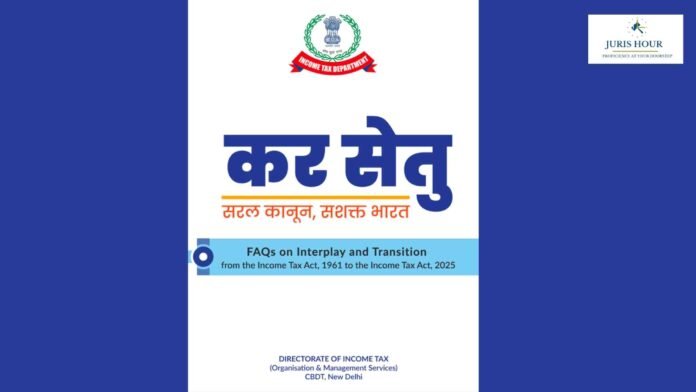
The Central Board of Direct Taxes (CBDT) has issued a detailed compendium of Frequently Asked Questions (FAQs). The document lays down the legal and procedural roadmap for transitioning from the six-decade-old Income-tax Act, 1961 to the modernised tax framework effective from April 1, 2026.
Objective: Simplification Without Increasing Tax Burden
The CBDT clarified that the new legislation is aimed at simplifying the tax structure rather than introducing new taxes or increasing the burden on taxpayers. The Income-tax Act, 2025 has been designed to streamline provisions, reduce complexity, and improve readability by consolidating scattered provisions and eliminating redundant clauses.
According to the FAQs, the older law had become increasingly complex due to numerous amendments over time. The new Act restructures provisions into a more logical format, incorporates explanations into the main text, and enhances clarity to reduce interpretational disputes.
Repeal of 1961 Act with Safeguards for Continuity
While the Income-tax Act, 1961 will stand repealed from April 1, 2026, the CBDT emphasized that this will not disrupt ongoing proceedings or past assessments. All matters relating to tax years prior to this date—including assessments, reassessments, appeals, and penalties—will continue to be governed by the old Act.
The transition is governed by Section 536 of the new law, which provides a comprehensive “repeal and savings” framework. This ensures that rights, liabilities, and obligations arising under the old Act remain intact, thereby preventing legal uncertainty.
Introduction of ‘Tax Year’ Replaces Assessment Year Concept
One of the most notable reforms is the introduction of the concept of “Tax Year,” replacing the earlier dual system of “previous year” and “assessment year.” The CBDT explained that a tax year will now align with the financial year, thereby eliminating confusion caused by referencing two different periods.
Income earned from April 1, 2026 onwards will be assessed under the new Act as “Tax Year 2026–27,” whereas income earned up to March 31, 2026 will continue to be assessed under the old regime as Assessment Year 2026–27.
No Overlap or ‘Missing Year’ in Transition
Addressing concerns regarding potential gaps, the FAQs categorically state that there will be no overlap or missing year during the transition. The existing system will seamlessly shift, with each income period clearly mapped to its respective governing law.
Compliance Structure Largely Unchanged
The CBDT has retained the core compliance framework, including tax payment mechanisms such as Tax Deducted at Source (TDS), advance tax, and self-assessment tax. While the structure has been simplified, there is no major policy shift in tax collection procedures.
TDS provisions, for instance, have been consolidated into fewer sections with tabular formats, making them easier to interpret. Similarly, advance tax provisions continue with the same instalment schedule and thresholds.
Parallel Operation of Both Laws During Transition Phase
The FAQs highlight that both the old and new tax laws will operate simultaneously for a transitional period. Taxpayers will need to comply with the old Act for earlier years while adhering to the new Act for income earned from April 2026 onwards.
The income tax e-filing portal will be equipped to handle compliance under both regimes. For example, taxpayers filing returns for Assessment Year 2026–27 in July 2026 will use forms under the old Act, while advance tax payments for the same financial year (2026–27) will be governed by the new Act.
Filing of Returns: No Dual Filing Requirement
Importantly, the CBDT clarified that taxpayers will not be required to file two returns for the same period. Returns for Tax Year 2026–27 will only be due in 2027, following the completion of that financial year, in line with the existing framework.
Carry Forward of Losses and Tax Credits Protected
The FAQs also provide reassurance that tax benefits such as carry-forward of losses and Minimum Alternate Tax (MAT) credits under the old Act will continue to be available under the new regime. These benefits will be subject to existing conditions and timelines, ensuring no disadvantage to taxpayers.
Continuation of Administrative Framework
Existing systems such as Permanent Account Number (PAN), Tax Deduction Account Number (TAN), and faceless assessment schemes will remain operational under the new Act. The CBDT has also introduced simplified forms for new registrations and compliance filings to enhance user experience.
Guidance for Taxpayers
The CBDT has advised taxpayers to maintain clear segregation of financial records between the two regimes during the transition year. Proper classification of payments, returns, and tax credits will be crucial to avoid compliance errors.
Conclusion
The release of the FAQ compendium marks a crucial step in India’s tax reform journey. By addressing key concerns relating to transition, compliance, and continuity, the CBDT aims to facilitate a smooth migration to a modern, transparent, and taxpayer-friendly tax system.

