
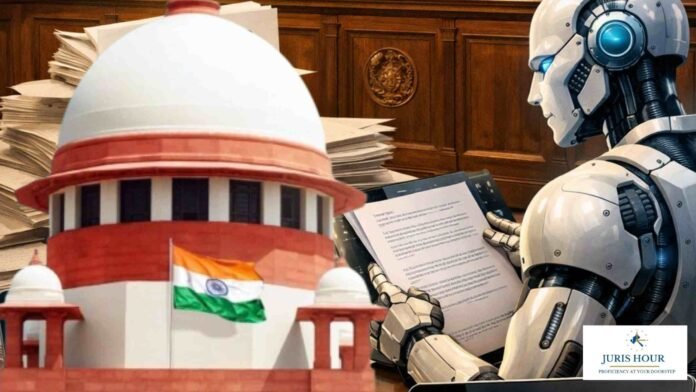
The Supreme Court stated that the AI-Generated fake judgments threat to the judicial integrity.
The bench of Justice Pamidighantam Sri Narasimha and Justice Alok Aradhe has taken cognizance of a case where a trial court allegedly relied on artificial intelligence (AI)-generated, non-existent judicial precedents while deciding a matter. The Court has termed the issue as one of “institutional concern,” emphasizing that such practices strike at the very foundation of adjudication.
The matter arose from a Special Leave Petition filed against a judgment of the Andhra Pradesh High Court. The petitioners, who are defendants in an injunction suit, challenged the trial court’s reliance on certain judicial precedents while dismissing their objections to an Advocate Commissioner’s report. They contended that the cited judgments were fabricated and did not exist in law.
Upon examination, the High Court acknowledged that the cited rulings appeared to be AI-generated and non-existent. While it issued a word of caution, it proceeded to decide the case on merits and upheld the trial court’s order. Aggrieved by this approach, the petitioners approached the Supreme Court.
The court underscored that the issue extends beyond mere adjudication on merits and touches upon the process of judicial determination itself. The Court observed that reliance on fabricated or synthetic judgments is not a simple error in decision-making but could amount to misconduct with serious legal consequences.
The Court has stayed further proceedings before the trial court insofar as they are based on the Advocate Commissioner’s report, directing that no action be taken relying on the impugned material until further orders.
The apex court has decided to examine the broader implications of such practices, particularly the use of AI tools in legal adjudication without proper verification. It has issued notices to the Attorney General, Solicitor General, and the Bar Council of India, signaling a wider institutional review of the issue.
To assist in this critical inquiry, the Court has appointed senior advocate Shyam Divan as amicus curiae, tasking him with aiding the bench in addressing the legal and ethical ramifications.
The case marks one of the first instances where the Supreme Court has directly engaged with the misuse of AI in judicial proceedings. By categorizing reliance on fake precedents as potential misconduct rather than mere judicial error, the Court has sent a strong signal regarding accountability and the sanctity of the legal process.
The matter is now slated for further hearing, where the Court is expected to lay down important guidelines on the use of AI in courts and the standards of verification required to maintain the credibility of judicial outcomes.
Case Details
Case Title: Gummadi Usha Rani v. Sure Mallikarjuna Rao
Case No.: Special Leave to Appeal (C) No(s). 7575/2026
Date: 27-02-2026
Read More: Reassessment Quashed Citing Invalid Sanction from Incompetent Authority Beyond 3 Year Limit: ITAT

