
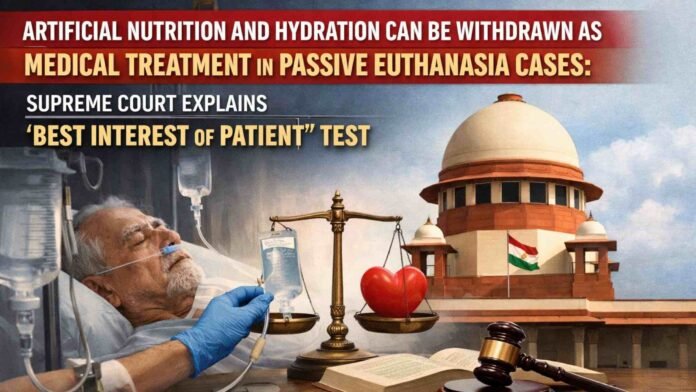
The Supreme Court has held that artificial nutrition and hydration can be withdrawn as medical treatment in passive euthanasia cases.
The court while clarifying that Clinically Assisted Nutrition and Hydration (CANH) constitutes medical treatment and may be withdrawn in appropriate cases under the passive euthanasia framework.
The bench of Justice J.B. Pardiwala, also provides detailed guidance on how the “best interest of the patient” test should be applied when patients are unable to make decisions for themselves.
The Court examined the constitutional and ethical dimensions of passive euthanasia while elaborating on the legal principles earlier laid down in Common Cause v. Union of India, which recognised the legality of passive euthanasia and advance medical directives.
Background of the Case
The matter came before the Supreme Court through a miscellaneous application filed by Harish Rana seeking clarification regarding implementation of the passive euthanasia guidelines issued in earlier Supreme Court rulings. The application raised several issues concerning withdrawal of life-sustaining treatment and the scope of medical decision-making in cases where patients are terminally ill or permanently incapacitated.
The Court therefore undertook an extensive examination of the legal framework governing passive euthanasia, patient autonomy, and medical ethics.
Active vs Passive Euthanasia
At the outset, the Court reaffirmed the legal distinction between active euthanasia and passive euthanasia. Active euthanasia, which involves directly causing a patient’s death through an act such as administering a lethal drug, remains illegal in India.
Passive euthanasia, however, refers to withholding or withdrawing life-sustaining medical treatment, including ventilators, feeding tubes, or other clinical interventions, when such treatment only prolongs suffering without offering therapeutic benefit.
The Court reiterated that passive euthanasia is permissible under Indian law when it is carried out in accordance with constitutional principles and established safeguards.
Artificial Nutrition and Hydration Treated as Medical Treatment
One of the central legal issues before the Court was whether artificial nutrition and hydration administered through medical devices should be treated as basic care or as medical treatment.
After analysing international jurisprudence and medical practice, the Court concluded that Clinically Assisted Nutrition and Hydration (CANH) is not merely basic care but a form of medical treatment. Since such feeding often involves invasive medical procedures and clinical supervision, it falls within the category of life-sustaining treatment.
The Court therefore clarified that CANH may be withheld or withdrawn in appropriate circumstances, provided that the decision satisfies the legal test of the patient’s best interests and follows the prescribed safeguards.
The “Best Interest of the Patient” Test
A substantial part of the judgment deals with the interpretation of the “best interest of the patient” principle, which becomes relevant when a patient is unconscious or incapable of expressing consent.
The Court held that determining the best interest of the patient requires a careful assessment of several factors, including:
- the patient’s medical condition and prognosis
- the likelihood of recovery
- the extent of pain or suffering caused by continued treatment
- previously expressed wishes of the patient
- ethical obligations of medical professionals
- whether continued treatment merely prolongs the dying process
The Court emphasized that the preservation of biological life alone cannot be the sole objective if it results in prolonged suffering or loss of dignity.
Global Legal Perspectives
To explain the scope of the best-interest test, the Court undertook a comparative review of international jurisprudence from jurisdictions such as the United States, the United Kingdom, Australia, Ireland, and New Zealand.
The Court noted that courts across these jurisdictions recognise that life-sustaining treatment may be withdrawn when it no longer benefits the patient or only prolongs the process of dying.
These international precedents, the Court observed, reinforce the principle that patient dignity and welfare must remain central to end-of-life medical decisions.
Dignity and Autonomy Under Article 21
The Court further observed that the right to die with dignity is rooted in Article 21 of the Constitution, which guarantees the right to life and personal liberty. The Court held that the constitutional protection of life also includes the right to bodily integrity, autonomy, and dignity.
Forcing a patient to remain alive through invasive medical procedures in situations where recovery is impossible may undermine these constitutional values.
Role of Doctors in End-of-Life Decisions
The judgment clarified that doctors must act in the best interests of the patient, balancing their duty to preserve life with their responsibility to alleviate suffering.
Medical professionals may lawfully withdraw life-sustaining treatment when:
- recovery is medically improbable, and
- continued treatment serves no therapeutic purpose.
However, the Court stressed that such decisions must follow strict procedural safeguards and involve careful medical evaluation.
Advance Medical Directives
The Court also reiterated the validity and importance of Advance Medical Directives (living wills), which allow individuals to record their wishes regarding medical treatment in case they become incapable of making decisions later.
Living wills, the Court observed, strengthen patient autonomy and help guide doctors and families in difficult end-of-life situations.
Case Details
Case Title: Harish Rana Versus UOI
Citation: JURISHOUR-313-SC-2026
Case No.: Special Leave Petition (Civil) No. 18225 Of 2024
Date: 11/03/2026
Read More: SC Warns Against ‘Overzealous Investigation’

