
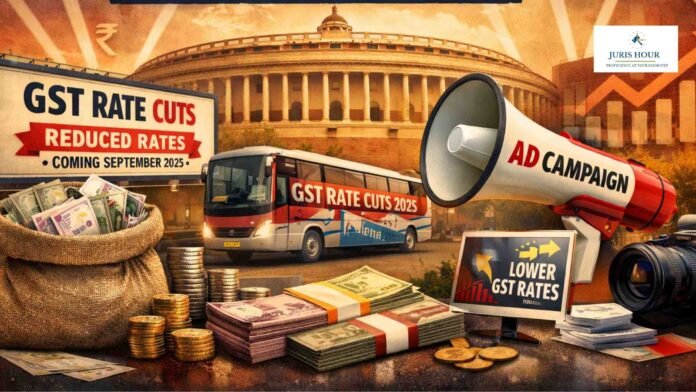
The Union Government spent close to Rs. 89 crore on promotional/ads campaigns to publicise the Goods and Services Tax (GST) rate reductions that came into effect in September 2025, the Finance Ministry informed Parliament.
According to a written reply presented in the Lok Sabha, Minister of State for Finance Pankaj Chaudhary stated that the government incurred ₹88.74 crore on advertisements related to the campaign titled “GST Bachat Utsav.” The initiative aimed to inform citizens and businesses about the tax rate rationalisation implemented last year.
Advertisement Campaign Around GST Rationalisation
The GST rate cuts were implemented from September 22, 2025, following a decision by the GST Council during its meeting earlier that month. The changes were part of a broader effort to simplify the indirect tax system and reduce the tax burden on commonly used goods.
In her announcement at the time, Finance Minister Nirmala Sitharaman had emphasised that the rationalisation exercise was undertaken with a focus on providing relief to the “common man.” Several everyday items saw tax reductions after detailed review by the Council.
To ensure that consumers were aware of the price impact of the tax reductions, the government launched an extensive communication drive across print, electronic, and digital media platforms. The campaign highlighted the potential savings consumers could expect after businesses adjusted prices in line with the revised GST rates.
Government Claims Benefits Reached Consumers
The Finance Ministry also stated that feedback from field formations of the Central Board of Indirect Taxes and Customs suggests that the benefits of the tax cuts were largely passed on to consumers.
“Based on inputs received from the field formations under the Central Board of Indirect Taxes and Customs, it has been observed that these benefits have largely been passed on to end-consumers following the GST rate reduction,” Chaudhary said in his reply.
The government monitored the price adjustments after the rate reduction to ensure compliance with anti-profiteering provisions under the GST framework.
Awareness Measures for Consumers
Apart from advertisements, the government also introduced several informational measures to assist consumers in understanding the revised tax structure.
These included: Publishing Frequently Asked Questions (FAQs) explaining the changes in GST rates; Uploading guidance materials on the CBIC website; Directing consumers to contact the National Consumer Helpline for assistance; and Allowing grievances regarding non-implementation of GST benefits to be filed through the Integrated Grievance Redressal Mechanism (INGRAM) portal.
These measures were intended to ensure that consumers could report cases where businesses failed to reflect the lower GST rates in retail prices.
Rate Rationalisation and Industry Response
The September 2025 GST reforms were part of a wider rationalisation exercise designed to streamline the tax regime into a two-tier structure of 5% and 18% for most goods and services. Several items used by households underwent detailed review before the Council recommended lower rates.
In the weeks leading up to the implementation, many companies launched marketing campaigns and promotional offers highlighting potential price reductions to attract customers once the revised tax rates took effect.
The government’s communication campaign aimed to reinforce this message and encourage consumers to take advantage of the reduced tax burden.
Parliamentary Disclosure
The expenditure details were disclosed in response to a question raised in Parliament seeking information on the government’s spending on advertising related to GST reforms. The Finance Ministry clarified that the promotional efforts were meant to create awareness and ensure transparency regarding the tax changes affecting consumers and businesses.
The disclosure highlights the scale of the government’s outreach campaign accompanying one of the most significant GST rate rationalisations undertaken in recent years.
Read More: JURISHOUR | TAX LAW DAILY BULLETIN : MARCH 9, 2026

