
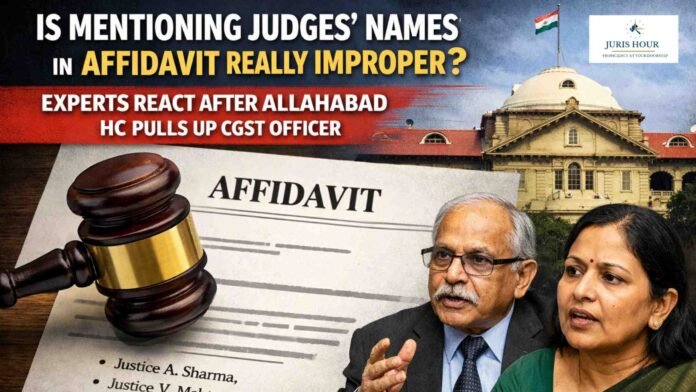
The Allahabad High Court has reprimanded a Central GST officer for citing judicial precedents in an affidavit by mentioning the names of the judges who delivered the rulings, a move that has sparked debate among legal experts on the conventions of legal drafting in court pleadings.
The bench of Justice Samit Gopal observed that while referring to judgments in court documents such as affidavits, it is unnecessary to mention the names of the judges who authored or delivered the decision. According to the Court, only the names of the parties, the date of the decision, the case citation, and the relevant legal extract are required to properly rely upon a precedent.
Court Objects to Citation Style in Affidavit
The Court examined a counter affidavit filed by a CGST Assistant Commissioner in which several decisions of the Supreme Court of India and High Courts were cited. While referring to the decision in Ram Narain Popli v. Central Bureau of Investigation, the deponent officer also mentioned the names of the judges who constituted the bench that decided the case.
The Court noted that the practice of including the names of judges while citing precedents in affidavits was “totally uncalled for.” The bench emphasized that the focus should remain on the legal proposition emerging from the judgment rather than on the identity of the judges who delivered it.
Directions Issued by the Court
Taking note of the issue, the Court directed the Registrar (Compliance) to communicate its order to the relevant authorities for information and necessary action.
The order is to be forwarded to the District and Sessions Judge, Gautam Budh Nagar and the concerned court. It has also been directed to be sent to the Director General, Central Goods and Services Tax, Gurugram Commissionerate, so that the concerned officer is cautioned and such drafting practices are avoided in future.
Experts Raise Questions Over the Court’s View
Following the order, the issue triggered extensive discussion among legal experts and tax administrators regarding whether mentioning the names of judges while citing precedents is inherently improper.
Some experts pointed out that courts themselves occasionally refer to judges by name while discussing earlier decisions, particularly when highlighting the author of an important opinion or when referring to benches led by prominent judges. In several reported judgments, courts have also mentioned the designation of judges, such as referring to a judge who later became the Chief Justice of India.
Because of this, some commentators questioned the basis for discouraging the practice altogether in pleadings.
Another concern raised during the discussions was that the officer who signed the affidavit may not necessarily have drafted it personally. In many government litigation matters, affidavits are often prepared by departmental staff before being signed by the officer acting as the deponent.
According to some experts familiar with departmental litigation practices, in tax matters within government departments, inspectors or superintendents frequently prepare drafts which are later vetted and signed by the concerned officer.
Distinction Between Judgments and Pleadings
Legal experts also highlighted that the Court’s objection relates specifically to court documents such as affidavits, petitions and pleadings, rather than to judicial decisions themselves.
While courts sometimes refer to judges by name in their own judgments, practitioners noted that in pleadings filed before courts the emphasis should generally be on the ratio or legal principle laid down in the precedent rather than on the identity of the judges who delivered it.
At the same time, some experts observed that merely mentioning judges’ names does not necessarily affect the substance of a legal argument, particularly when the citation itself is otherwise complete and accurate.
Debate on Drafting Standards
The episode has also reignited discussion on the quality of drafting in government litigation. Legal commentators stressed that affidavits filed before High Courts are expected to follow standard pleadings and conveyancing practices commonly accepted across courts in India.
Repeatedly mentioning the names of judges without highlighting the key legal observations from the cited judgments may, according to some experts, weaken the clarity of legal submissions.
The ruling has therefore opened a broader conversation within legal circles about citation practices, drafting standards, and the responsibility of government departments to ensure properly structured pleadings before constitutional courts.
As the debate continues among practitioners and legal experts, the issue has highlighted the evolving conventions surrounding how judicial precedents should be cited in court documents.
Source: This article has been prepared based on the opinions, perspectives, and legal inputs shared by senior tax administrators and indirect tax experts during a discussion in the Elite GST@Chitkara Sir.JurisHour WhatsApp group. The views reflected are part of a professional exchange of ideas on evolving GST jurisprudence and should be understood in the context of that discussion.
Read More: CAG’s Role in GST Audits Questioned: Concerns Over Indirect Access to Taxpayer Documents

