
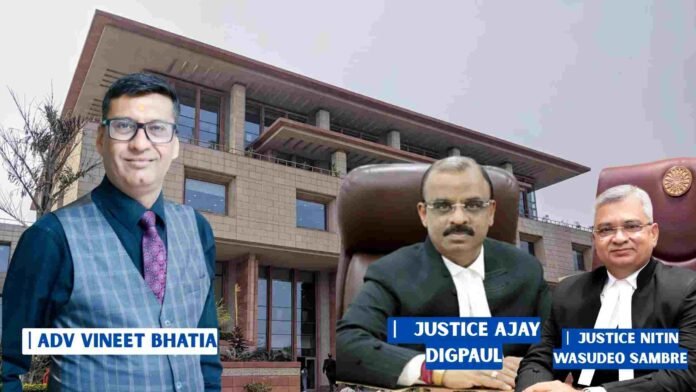
The Delhi High Court has directed the Standing Counsel for the Delhi Government, Sameer Vasistha, to file an affidavit within two weeks clarifying the legality of the appellate framework under the Delhi State Goods and Services Tax (DGST) regime where the appeals are being heard by Joint Commissioners or Additional Commissioners in cases where the original adjudication order was passed by a senior-ranking officer, namely a Special Commissioner.
The Bench of Justice Nitin Wasudeo Sambre and Justice Ajay Digpaul orally observed that conferring appellate jurisdiction on officers junior in rank to the adjudicating authority appears contrary to established principles of natural justice and administrative propriety. The Court has sought an urgent explanation from the Delhi Government on how such an arrangement aligns with the statutory framework of the DGST Act.
The direction came during the hearing of a writ petition challenging both the refund rejection procedure and the constitution of the Appellate Authority under the Delhi Goods and Services Tax (DGST) Act.
The matter was last heard on February 25, 2026, and is now listed for further consideration in March 2026.
During the hearing, the Court expressed surprise that appeals are being heard by Joint Commissioners or Additional Commissioners in cases where the original adjudication order was passed by a senior-ranking officer, namely a Special Commissioner.
Earlier, on February 14, 2024, the Court had issued notice specifically on the challenge to the constitution of the Appellate Authority.
Background: Refund Rejection and “Risky Exporter” Tag
The dispute arises from a refund claim of Integrated GST (IGST) filed by the petitioner on account of exports made after payment of tax through shipping bills.
The petitioner was flagged as a “risky exporter,” following which the refund application was systemically transmitted to the GST proper officer via a system-generated FORM GST RFD-01 in accordance with Rule 96(5A) of the DGST Rules. Subsequently, a show cause notice was issued, and the refund was rejected through FORM GST RFD-06.
Aggrieved by the rejection and the procedure followed, the petitioner approached the High Court by way of a writ petition.
Challenge to Rule 96(5A) and Appellate Authority
The petitioner has challenged the legality of Rule 96(5A) and, more significantly, the constitution of the Appellate Authority under the DGST Act on two principal grounds:
- Hierarchy Violation in Appeals
The petitioner contended that appellate powers have been assigned to officers of the rank of Joint Commissioner, whereas the original order was passed by a Special Commissioner, who is senior in rank. It was argued that appeals against adjudication orders must be heard by officers senior to the adjudicating authority to ensure fairness and institutional integrity. - Violation of Section 5(4) of the DGST Act
The petitioner further submitted that the DGST Department (Department of Trade and Taxes) has assigned both adjudicatory and appellate functions to the same officers, which is allegedly in contravention of Section 5(4) of the DGST Act. According to the plea, this overlapping of roles undermines the statutory separation of functions and raises serious concerns regarding impartiality.
Additionally, it was pointed out that the Appellate Authority in Delhi State GST is entrusted with multiple administrative and quasi-judicial responsibilities apart from appellate functions, raising questions about institutional independence.
Court Seeks Detailed Affidavit
Taking note of the constitutional and administrative issues raised, the High Court has directed the Respondents to urgently seek instructions and file a detailed affidavit explaining the legal foundation of the current appellate mechanism under the DGST Act.
The affidavit is expected to address: Whether the assignment of appellate powers to officers junior in rank to the adjudicating authority is legally sustainable; How the dual allocation of adjudicatory and appellate functions complies with Section 5(4) of the DGST Act; and The administrative rationale behind the existing structure.
The matter is scheduled to be taken up again in March 2026, and the outcome could have significant implications for the appellate framework under the Delhi State GST regime, particularly in cases involving export refunds and systemic risk-based flagging of taxpayers.
Case Details
Case Title: M/S. Geonix International Pvt. Ltd. Versus UOI
Case No.: W.P.(C) 2134/2024
Date: 06.02.2026
Counsel For Petitioner: Advocates Vineet Bhatia and Mr. Abhinav Sharde
Counsel For Respondent: K.G. Gopalakrishnan

