
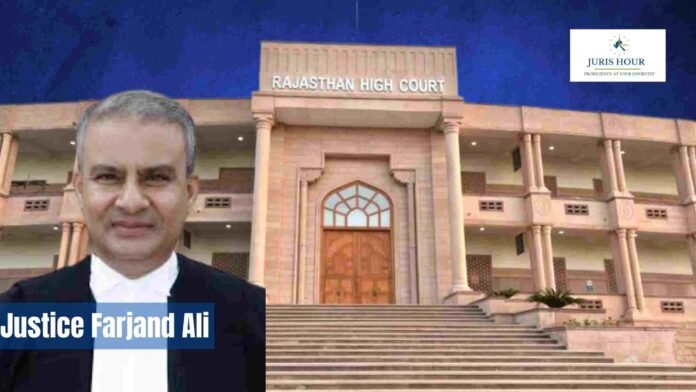
The Rajasthan High Court has directed an independent inquiry into the conduct of a Judicial Officer over serious discrepancies in court records relating to the denial of statutory default bail to a juvenile accused in a POCSO case.
The bench of Justice Farjand Ali has observed that default bail under Section 187 BNSS is not discretionary but an indefeasible right once the statutory period expires and the accused expresses readiness to furnish bail. Continued detention beyond the statutory period, the Court said, would violate Article 21 of the Constitution.
The bench said, “the scope of an inquiry against a judicial officer is neither punitive in its inception nor condemnatory in its tone; it is essentially fact-finding in character, undertaken to preserve the purity of the judicial institution. Such an inquiry does not sit in appeal over the judicial reasoning of the officer, nor is it meant to scrutinize the correctness of an order on merits, which is the domain of appellate or revisional jurisdiction. The inquiry is confined to examining whether there has been any conduct unbecoming of a judicial officer, any procedural impropriety of a grave nature, any act suggestive of mala fides, fabrication, or deliberate deviation from the record, or any behaviour that shakes public confidence in the administration of justice. It must remain circumscribed by the principles of natural justice, ensuring full opportunity to the concerned officer to explain the circumstances appearing against him or her. At the same time, the inquiry must be sufficiently robust to ascertain the truth, for the majesty of law rests not merely on the correctness of outcomes but on the transparency and integrity of the process. Thus, the exercise is a delicate balance, protecting judicial independence on the one hand, while safeguarding institutional credibility and accountability on the other.
The court stated, “The principles of natural justice are not empty formalities. No adverse conclusion can be drawn unless a fair and impartial inquiry is conducted and the concerned officer is afforded a full opportunity to explain the circumstances. Nevertheless, the material on record is sufficient to persuade this Court that an independent inquiry is warranted so that the truth is unearthed and the lingering doubt is dispelled. Doubt, when it creeps into the record of a court, must either be substantiated through due process or decisively eliminated; but in no way be allowed to remain festering.”
Background of the Case
The case arose from FIR registered at Police Station Luni, Jodhpur, alleging gang rape and criminal intimidation under the Bharatiya Nyaya Sanhita (BNS) and provisions of the POCSO Act. The petitioner, a juvenile aged about 17 years and 8 months at the time of apprehension, was taken into custody on 28 August 2025 and lodged in a Child Welfare Home.
After completion of 90 days from the date of detention, the juvenile invoked his right to statutory/default bail under Section 187 of the Bharatiya Nagarik Suraksha Sanhita (BNSS). The Juvenile Justice Board rejected the plea on the ground that the charge-sheet had been filed on 21 November 2025. The appellate court affirmed this view, leading to the revision petition before the High Court.
High Court Flags Chronological Impossibility
Upon examining the record, the High Court found significant inconsistencies. It noted the absence of any contemporaneous order-sheet dated 21 November 2025 recording filing of the charge-sheet. The only material relied upon was an endorsement on the reverse of the charge-sheet cover, allegedly made by the Presiding Officer himself.
Further, an order-sheet dated 24 November 2025 recorded rejection of a bail application, even though the bail plea was admittedly filed on 28 November 2025 and decided on 29 November 2025. The Court observed that a judicial order cannot precede the event it records, terming the situation chronologically untenable.
The Court also found it inconsistent that on 28 November 2025, the Board called for the case diary, despite claiming that the investigation had already culminated in filing of the charge-sheet a week earlier.
Statement of Prosecutrix Does Not Implicate Juvenile
Another factor that weighed with the Court was the prosecutrix’s sworn statement recorded during trial. She named only the co-accused and did not attribute any role or presence to the juvenile petitioner. The High Court observed that such omission assumed significance at the stage of bail.
Default Bail Held a Constitutional Mandate
The Court also emphasized that under Section 12 of the Juvenile Justice Act, bail is the rule for a child in conflict with law unless specific statutory exceptions apply.
Inquiry to Safeguard Institutional Integrity
While refraining from recording any conclusive finding, the High Court observed that the circumstances gave rise to a serious and disturbing doubt regarding the sanctity of judicial records. It directed the registry that the matter be placed before the Chief Justice for initiating an independent inquiry against in the matter.
The Court clarified that the inquiry is fact-finding in nature and aimed at preserving institutional credibility, underscoring that judicial independence must coexist with accountability.
Conclusion
Allowing the criminal revision petition, the High Court set aside the orders of the Board and the appellate court, and granted default bail to the juvenile. The judgment serves as a strong reaffirmation that statutory bail rights cannot be defeated by procedural irregularities and that the integrity of judicial records is fundamental to public confidence in the justice delivery system.
Case Details
Case Title: V Versus State of Rajasthan
Citation: JURISHOUR-25-HC-2026(Raj)
Case No.: S.B. Criminal Revision Petition No. 13/2026
Date: 17/02/2026
Counsel For Petitioner: Ravinder Kumar Singh
Counsel For Respondent: Manju Choudhary

