
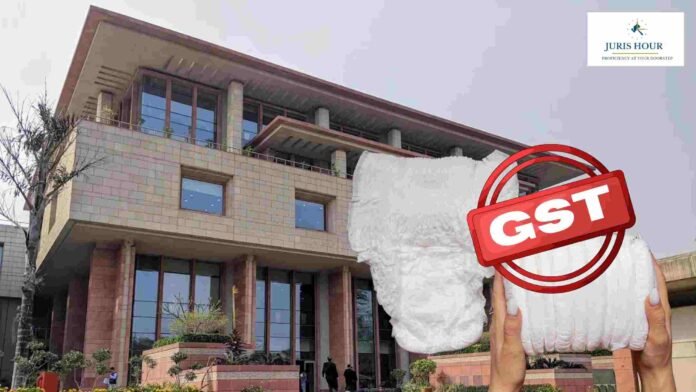
The Delhi High Court has directed the Union government to examine and decide, within six months, a representation seeking exemption of adult and clinical diapers from the Goods and Services Tax (GST), which is presently levied at 5 per cent. The Court was hearing a writ petition challenging the tax as arbitrary and discriminatory, particularly in its impact on persons with disabilities and others who depend on such products for basic hygiene and dignity.
The bench of Justice Nitin W. Sambre and Justice Ajay Digpaul issued the direction on February 12, 2026, while refraining from granting any immediate relief on the exemption itself. Instead, the Court instructed the authorities to consider the petitioners’ representation and pass a reasoned decision within the stipulated timeframe.
The plea was filed by Swarnalatha J. and T.S. Guruprasad, both persons with disabilities, who argued that adult and clinical diapers are indispensable hygiene products rather than discretionary or luxury goods. According to the petition, taxing such products undermines affordability and discourages their use, thereby affecting health, mobility, and dignity.
Senior Advocate Shyel Trehan, appearing for the petitioners along with Advocates Rishabh Sharma and Ambica Sood, submitted that there is no rational basis for treating adult diapers differently from sanitary napkins, which were exempted from GST in 2018 after being recognised as essential hygiene items.
Counsel argued before the Court that the functional purpose of adult diapers and sanitary pads is comparable—both are necessary to maintain personal hygiene and prevent infections—and therefore differential taxation lacks any intelligible differentia.
The petition contends that the continued taxation violates fundamental rights guaranteed under Articles 14, 19, and 21 of the Constitution of India, particularly the rights to equality, dignity, and personal liberty. It also alleges inconsistency with protections under the Rights of Persons with Disabilities Act, 2016, which aims to promote accessibility and remove barriers affecting persons with disabilities.
The petitioners emphasized that households dealing with disabilities often face substantial recurring medical and caregiving expenses, and the GST burden on essential hygiene products exacerbates financial strain.
The case details the condition of one of the petitioners, a woman with 80% disability diagnosed with Primary Progressive Multiple Sclerosis (PPMS), a degenerative neurological disorder that has rendered her quadriplegic and wheelchair-dependent. She requires daily use of disposable adult diapers due to loss of bowel control and needs continuous caregiver assistance.
According to the plea, she uses eight to ten diapers per day, making the cumulative cost of GST significant and unavoidable. Her husband, who has a 40% locomotor disability and serves as her primary caregiver, jointly runs a non-profit organisation working in disability rights and accessibility.
The petition argues that the tax burden disproportionately affects vulnerable groups, including persons with disabilities, senior citizens, and individuals suffering from chronic illnesses.
Counsel appearing for the authorities opposed the plea, submitting that decisions regarding GST exemptions fall within the domain of fiscal policy and require deliberation by the GST Council, which includes representatives from both the Centre and the states. It was argued that such exemptions cannot be granted unilaterally through executive action.
Taking note of the submissions, the High Court did not rule on the merits of the exemption at this stage but directed the Centre to consider the petitioners’ representation—submitted in September 2025—and arrive at a reasoned decision within six months.
The matter brings renewed attention to the broader debate on GST classification of essential hygiene products and raises questions about the intersection of tax policy, public health, and the rights of persons with disabilities.
Case Title: Swarnalatha J. & Anr. v. Union of India
Date of Hearing: February 12, 2026
Read More: RBI Tightens Bank Lending Norms for Stock Brokers

