
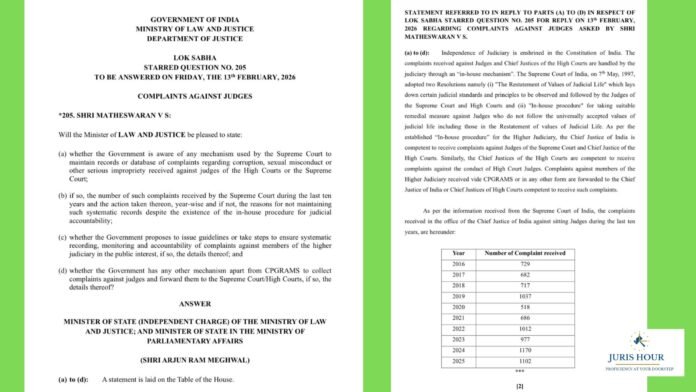
The Union Government on Friday informed the Lok Sabha that complaints against sitting judges of the Supreme Court and High Courts are dealt with through an “in-house mechanism” evolved by the higher judiciary, underlining the constitutional principle of judicial independence.
Replying to a starred question in the Lok Sabha on February 13, 2026, Minister of State (Independent Charge) for Law and Justice Arjun Ram Meghwal stated that complaints received against judges are handled internally by the judiciary in accordance with resolutions adopted by the Supreme Court.
The response came in reply to Starred Question No. 205 raised by MP Shri Matheswaran V.S. regarding complaints alleging corruption, sexual misconduct, or other serious impropriety against judges of the higher judiciary.
In-House Procedure Governs Complaints
The Government clarified that the independence of the judiciary is enshrined in the Constitution of India and that complaints against Judges and Chief Justices of High Courts are addressed by the judiciary itself through an “in-house mechanism.”
It referred to two resolutions adopted by the Supreme Court of India on May 7, 1997:
- The Restatement of Values of Judicial Life, which lays down judicial standards and principles to be observed by judges of the Supreme Court and High Courts; and
- The In-House Procedure, which provides for remedial measures against judges who fail to adhere to accepted judicial values.
Under this mechanism, the Chief Justice of India is competent to receive complaints against judges of the Supreme Court and Chief Justices of High Courts. Similarly, Chief Justices of High Courts are empowered to receive complaints regarding the conduct of High Court judges.
The Government further stated that complaints received through CPGRAMS or any other mode are forwarded to the Chief Justice of India or the respective Chief Justices of High Courts, as competent authorities.
Year-Wise Complaints in Last 10 Years
As per information provided by the Supreme Court, the number of complaints received in the office of the Chief Justice of India against sitting judges over the past decade is as follows:
- 2016 – 729
- 2017 – 682
- 2018 – 717
- 2019 – 1,037
- 2020 – 518
- 2021 – 686
- 2022 – 1,012
- 2023 – 977
- 2024 – 1,170
- 2025 – 1,102
In total, 8,630 complaints were received between 2016 and 2025.
The data shows a significant spike in 2019, followed by a dip in 2020, and a renewed upward trend from 2022 onwards, with 2024 recording the highest number of complaints in the decade.
No Separate Government Mechanism
In response to queries about whether the Government proposes to introduce guidelines or take steps to ensure systematic recording and monitoring of complaints against members of the higher judiciary, the Minister reiterated that such matters fall within the judiciary’s domain under the existing in-house procedure.
The Government also clarified that apart from forwarding complaints received via CPGRAMS, it does not have any separate mechanism to independently collect or process complaints against judges.
The reply underscores the continuing reliance on internal judicial accountability processes, even as questions regarding transparency and public oversight over complaints against members of the higher judiciary remain a subject of debate.

