
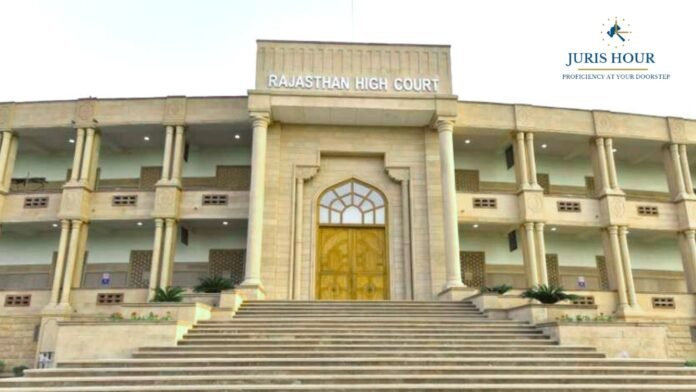
The Rajasthan High Court has directed the removal or relocation of all encroachments within the Right of Way (ROW) of National Highways across the State within two months, declaring that any occupation within the prohibited highway zone is per se illegal and incapable of regularisation.
The Division Bench of Justice Dr. Pushpendra Singh Bhati and Justice Sandeep Shah passed the reportable order while hearing a writ petition concerning a Dharmkanta (weighbridge) located near a National Highway in Jodhpur. The Court noted that the issue extended far beyond the individual weighbridge and exposed a systemic pattern of hazardous encroachments across Rajasthan’s highways.
Tragic Accident Triggers Wider Scrutiny
Recalling its earlier order dated January 22, 2026, the Court took judicial notice of communications from the PWD, JDA, NHAI and police authorities, as well as a tragic accident near the Dharmkanta in question that resulted in the loss of four lives. The Bench had previously expressed serious concern over violations of norms prohibiting construction within restricted highway zones measured from the centreline.
During the present hearing, the applicant sought additional time for voluntary relocation of the weighbridge. The Court granted 30 days’ extension, modifying the deadline to March 6, 2026, but clarified that the matter had revealed a much larger and disturbing pattern of encroachments within the ROW of National Highways.
Technical Norms and Safety Zones Explained
The Court examined the statutory framework under the National Highways Act, 1956, the Control of National Highways (Land and Traffic) Act, 2002, and standards prescribed by the Indian Roads Congress (IRC).
As explained before the Court the road land boundary/building line typically lies 40 metres from the centreline on either side (overall width 80 metres). The control line lies approximately 75 metres from the centreline on either side (overall width 150 metres). The ROW includes the carriageway, shoulders, drains, verges, safety margins, sight distance zones and land reserved for emergency use and future expansion.
The Bench clarified the legal position any occupation within the ROW or road land boundary is impermissible and liable to removal. No construction is permissible within the building line. Only regulated construction with statutory permission is permissible within the control line.
Road Safety as a Constitutional Obligation Under Article 21
Invoking Article 21 of the Constitution, the Court held that the right to life includes the State’s positive obligation to ensure safe movement on public roads and highways. Encroachments impairing sight distance, creating uncontrolled access points, or interfering with traffic flow are not merely statutory violations but constitutional wrongs.
The Bench referred to national road safety data published by the Ministry of Road Transport and Highways for 2023, which recorded 4,80,583 road accidents, 1,72,890 fatalities and nearly 30% of total road deaths occurring on National Highways, though they constitute only about 2% of total road length
The Court observed that unauthorised roadside activities such as commercial establishments, weighbridges and other structures within highway safety zones significantly increase accident risk due to sudden entry/exit points, pedestrian spillover and obstruction of visibility.
2,216 Encroachments Identified Across Rajasthan
Preliminary district-wise data placed before the Court revealed a startling number of encroachments within the ROW of National Highways across Rajasthan:
- 103 religious structures
- 881 residential structures
- 1,232 commercial establishments (including hotels and dhabas)
The Court observed that the issue was systemic and attributable to administrative fragmentation. Different departments had allegedly granted licences, electricity connections, mining clearances, trade approvals and weighbridge permissions without reference to highway control lines or ROW restrictions.
“Permissions granted by the Mining Department, Legal Metrology authorities, local bodies, electricity or water authorities, or trade licensing authorities cannot operate as a defence if a structure falls within the prohibited Highway zone,” the Court held, adding that there can be no estoppel against statute or public safety.
No Immunity Even for Religious Structures
The Bench made it clear that religious structures cannot claim immunity if situated within highway land. Relying on the Supreme Court’s ruling in Union of India v. State of Gujarat (2009), the Court reiterated that temples, mosques, churches or other religious constructions on public roads or utility spaces must be removed in the interest of traffic safety and public order.
Two-Month Deadline and Institutional Mechanism
In a sweeping direction, the Court ordered removal or relocation of all encroachments within the prohibited ROW within two months. Filing of a district-wise status report within two months, supported by GIS mapping, demarcation records and photographs.
The court sought clarification on whether rules regulating roadside activities under Sections 138(1A) and 210-D of the Motor Vehicles Act, 1988 have been framed, in compliance with the Supreme Court’s directions in S. Rajaseekaran v. Union of India (2025).
The Court further mandated that the constitution of a District Highway Safety Task Force within seven days in each district. GPS-based demarcation and videography of ROW, building lines and control lines. Maintenance of a district-wise Encroachment Register with geo-coordinates and photographs. Immediate review and suspension of licences or permissions granted within highway safety zones. Installation of permanent boundary markers to prevent re-encroachment. Police protection during removal drives.
The Court declared that all occupations within ROW/road land boundaries shall be treated as per se illegal and incapable of regularisation.
Case Details
Case Title: Himmat Singh Gehlot Versus State of Rajasthan
Case No.: D.B. Civil Writ Petition No. 24826/2025
Date: 05/02/2026
Counsel For Petitioner: Sr. Adv. Rajesh Joshi Assisted by Mr. Rishi Soni, Kamini Joshi
Counsel For Respondent: Mahaveer Bishnoi, AAG

