
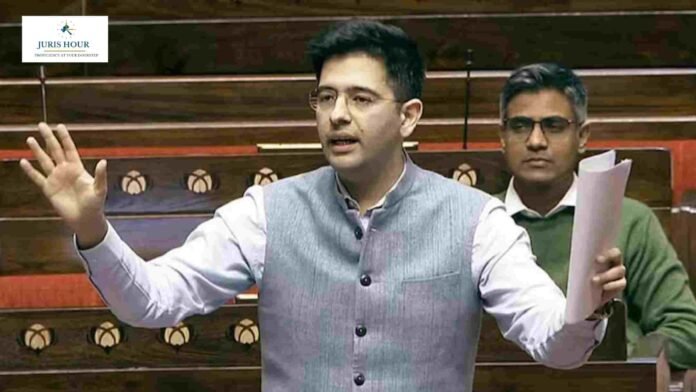
AAP MP Raghav Chadha on Monday made a strong pitch in Parliament for migrating India’s land and property records to blockchain technology, arguing that the existing system is riddled with inefficiencies, corruption, and endless litigation.
Citing alarming statistics on land disputes and title uncertainty, Chadha called for the creation of a National Blockchain Property Register to bring transparency, certainty, and speed to property transactions.
Addressing the House, Chadha said India’s land administration framework has become a major bottleneck for citizens, investors, and governments alike. He noted that ordinary citizens are often forced to run from one office to another for basic property-related services, while intermediaries and middlemen dominate registrar offices.
Land Records in “Utter Chaos”
Chadha highlighted that outdated processes, undervaluation through manipulated circle rates, and weak record-keeping have resulted in widespread cash transactions, tax leakages, fake documentation, and encroachments. According to him, disputes over property titles have become routine rather than exceptional, clogging India’s judicial system.
“The numbers tell the story,” Chadha said, pointing out that:
- 66% of all civil disputes in India relate to land and property,
- 45% of properties lack a clear title,
- 48% are already under dispute, and
- India ranks 133 out of 190 countries in property registration efficiency.
He further noted that even a simple property sale can take two to six months, while property-related cases take an average of seven years to be resolved by civil courts.
Digitisation Backlog and Governance Gaps
Despite multiple digitisation drives, Chadha said the task remains far from complete, with over 6.2 crore property documents still pending digitisation. He argued that partial digitisation without structural reform has merely shifted paperwork online without addressing deeper governance failures.
According to Chadha, the lack of a unified, tamper-proof system allows multiple versions of ownership records to coexist, increasing fraud and litigation while undermining investor confidence in real estate and infrastructure projects.
Case for a National Blockchain Property Register
To address these challenges, Chadha proposed the adoption of a blockchain-based land records system. He said blockchain technology could ensure:
- Time-stamped and tamper-proof records,
- Instant title verification,
- Real-time recording of sales, mutations, and inheritance, and
- End-to-end traceability of ownership history.
Such a system, he argued, would drastically reduce scope for forgery, discretionary manipulation, and post-facto alterations of land records.
Global Examples and India’s Opportunity
Drawing comparisons with international practices, Chadha cited countries such as Sweden, Georgia, and the UAE, where blockchain-backed property registries have significantly reduced transaction times and dispute rates. In some jurisdictions, property transfers are completed in minutes rather than months.
He stressed that India, with its scale and digital public infrastructure, is well placed to implement a similar reform if backed by political will and coordinated Centre–State action.
From Obstacle-Creating to Obstacle-Preventing System
Concluding his remarks, Chadha said India must urgently transition from a land record system that creates hurdles to one that prevents them. He argued that clean land titles are essential not only for citizens’ rights but also for boosting ease of doing business, infrastructure development, and formalisation of the economy.
“India must move from chaos to clarity,” he said, calling blockchain-based land governance a foundational reform rather than a technological luxury.
Read More: Forest Evictions Must Follow Due Process, Supreme Court Tells Assam Government

