
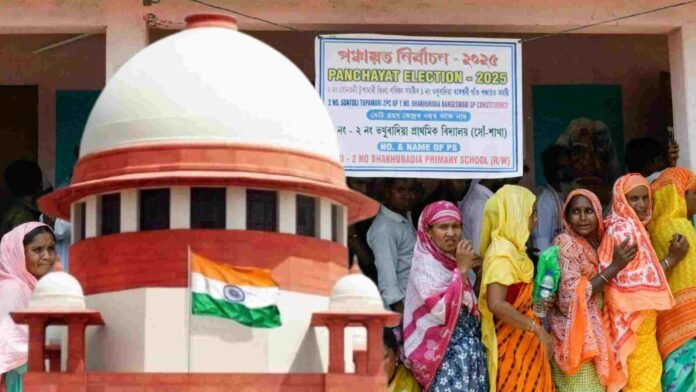
The Supreme Court has firmly reiterated the constitutional bar on judicial interference in Panchayat elections, holding that High Courts cannot intervene under Article 226 of the Constitution once the election process has commenced and a statutory remedy by way of an election petition is available.
A Bench comprising Justice Vikram Nath and Justice Sandeep Mehta categorically disapproved the High Court’s approach. The Court emphasized that Article 243-O places an express embargo on courts from calling Panchayat elections into question except through an election petition as provided under State law.
The ruling came in Sandeep Singh Bora v. Narendra Singh Deopa & Ors., where the apex court set aside an interim order of the Uttarakhand High Court that had allowed a disqualified candidate to re-enter the electoral fray.
The controversy arose during the Panchayat elections in Uttarakhand following a revised notification dated June 28, 2026, issued by the State Election Commission for resumption of elections in twelve districts. Narendra Singh Deopa filed his nomination for the post of Zila Panchayat Member from Constituency No. 11, Bharhgaon, District Pithoragarh.
An objection was raised by rival candidate Sandeep Singh Bora alleging that Deopa had failed to make mandatory disclosures in his nomination papers. Acting on the objection, the Returning Officer cancelled Deopa’s candidature on July 9, 2025.
Aggrieved, Deopa approached the Uttarakhand High Court by filing a writ petition. The Single Judge dismissed the petition on July 11, 2025, holding that once the election process had begun, judicial interference was barred and the appropriate remedy lay in filing an election petition under the Uttarakhand Panchayati Raj Act, 2016. On the same day, Bora was declared elected unopposed after the remaining candidates were disqualified.
High Court’s Interim Order Sparks Controversy
Deopa then filed an intra-court appeal before a Division Bench of the High Court—without impleading Bora. In an interim order dated July 18, 2025, the Division Bench stayed the Single Judge’s order and directed the Returning Officer to allot an election symbol to Deopa and permit him to contest the election.
This order prompted Bora to approach the Supreme Court, contending that the High Court had exceeded its jurisdiction and interfered with a concluded electoral process in violation of Article 243-O of the Constitution.
Supreme Court’s Analysis and Findings
The Bench noted that Uttarakhand has enacted a comprehensive statutory framework under the Uttarakhand Panchayati Raj Act, 2016, particularly Section 131H, which expressly provides a remedy for grievances arising from improper rejection of nomination papers. Once such an efficacious remedy exists, the High Court ought not to exercise its writ jurisdiction.
The Court relied on settled precedents, including N.P. Ponnuswami v. Returning Officer and Harnek Singh v. Charanjit Singh, to reiterate that challenges to nomination rejections must be raised only after the election process concludes, and exclusively through an election petition.
Key Errors Identified in the High Court’s Order
The Supreme Court found multiple infirmities in the Division Bench’s interim order. First, it violated the constitutional mandate of Article 243-O by entertaining the challenge mid-election. Second, it interfered with an election process that had already attained finality, as Bora had been declared elected unopposed. Third, the High Court passed adverse directions without hearing Bora, who was directly affected by the order.
The Bench observed that permitting such interventions would undermine electoral certainty and disrupt the democratic process at the grassroots level.
Allowing the appeal, the Supreme Court set aside the interim order dated July 18, 2025, passed by the Uttarakhand High Court and dismissed the writ appeal filed by Deopa. The Court underscored that individual electoral grievances must yield to the larger public interest of ensuring smooth, uninterrupted elections and must be pursued strictly through the statutory mechanism provided by law
Case Details
Case Title: Sandeep Singh Bora Versus Narendra Singh Deopa & Ors.
Case No.: SLP (C) NO.20241 OF 2025
Date: 02/02/2026

