
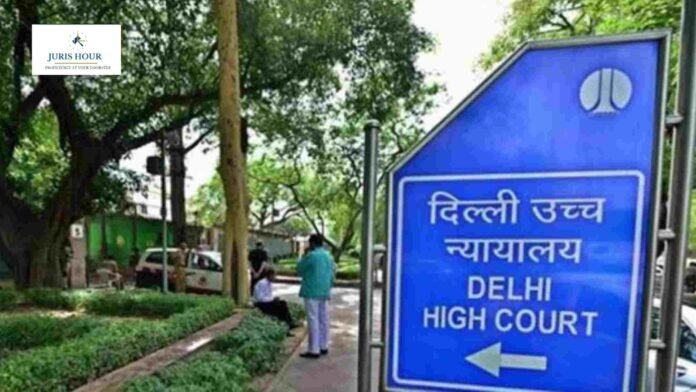
The Delhi High Court has dismissed a writ petition seeking declaration of lapse of land acquisition proceedings under Section 24(2) of the Right to Fair Compensation and Transparency in Land Acquisition, Rehabilitation and Resettlement Act, 2013, holding that mere non-taking of physical possession is not sufficient when compensation had already been deposited in court.
The Bench of Justice Nitin Wasudeo Sambre and Justice Anish Dayal acknowledged that there was no conclusive evidence of possession having been taken. However, the Court emphasized that Section 24(2) requires both conditions—non-taking of possession and non-payment of compensation—to be satisfied.
Background of the Dispute
The petition was filed by the legal heirs of late Shri Mohan Lal, namely Rameshwar Singh Tanwar and others, concerning land measuring 4 bighas and 14 biswas in Village Basai Dara Pur, Delhi. The land was acquired for planned development of Delhi through notifications issued under Sections 4 and 6 of the Land Acquisition Act, 1894 in 1959 and 1963, respectively.
An award was passed on May 29, 1964, fixing compensation at ₹2.50 per square yard. Dissatisfied with the quantum, the landowner sought enhancement under Section 18 of the 1894 Act.
Compensation Deposited, but Disbursement Stayed
The Land Acquisition Collector deposited ₹13,512.50 with the District Court in February 1965 under Section 31(2) of the 1894 Act. However, the disbursement of compensation remained stayed for decades due to a title dispute raised by a third party, M/s Bharat Builders & Colonisers, and at the request of the original landowner himself.
Following prolonged litigation, the Delhi High Court eventually enhanced compensation to ₹15.84 per square yard in 2011. Execution proceedings were initiated but later withdrawn by the petitioners.
Petition Under the 2013 Act
After the enactment of the 2013 Land Acquisition Act, the petitioners approached the High Court claiming that the acquisition had lapsed as neither possession had been taken nor compensation paid, invoking Section 24(2) of the 2013 Act.
They relied heavily on the absence of any record showing that physical possession of the land had been taken by the authorities.
Court’s Analysis and Legal Position
Placing reliance on the Constitution Bench ruling in Indore Development Authority v. Manohar Lal (2020), the Court reiterated that deposit of compensation in court constitutes valid tender where disputes exist; landowners who seek references or cause delay cannot later claim lapse; and Section 24(2) does not revive stale or concluded claims
Conduct of the Landowners Crucial
The Court noted that the compensation had been deposited as early as 1965, and the proceedings were stalled at the behest of the landowner due to pending disputes. The petitioners and their predecessor were fully aware of the deposit and had the opportunity to withdraw the amount once disputes concluded.
It was held that failure to withdraw compensation does not amount to non-payment, especially when litigation was pursued for enhancement.
Petition Held Time-Barred and Without Merit
The Bench also relied on the Supreme Court’s ruling in Mahavir v. Union of India (2018) to hold that Section 24(2) cannot be invoked to resurrect decades-old, settled acquisitions. The Court observed that allowing such claims would amount to abuse of process.
Concluding that compensation had been duly tendered and deposited, and that the petition suffered from inordinate delay, the Delhi High Court dismissed the writ petition and refused to grant any declaration of lapse or injunction.
Case Details
Case Title: Shri Rameshwar Singh Tanwar Versus Union Of India
Case No.: W.P.(C) 1442/2015
Date: 30th January, 2026
Counsel For Appellant: Gaurav Sarin, Senior Advocate
Counsel For Respondent: Sanjay Kumar Pathak
Read More: Budget 2026 Tightens Tax Rules for Sovereign Gold Bonds: Who Still Gets Exemption and Who Doesn’t?

