
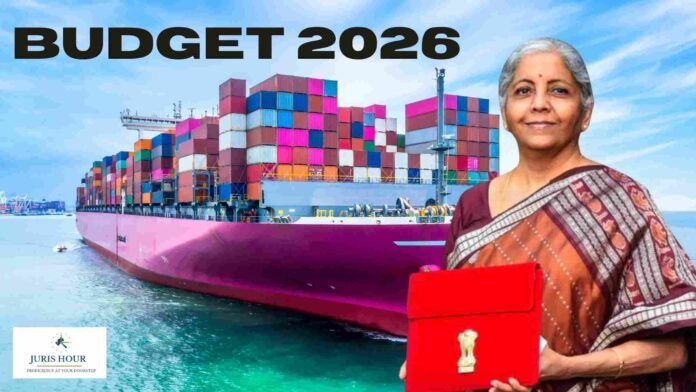
With the Union Budget 2026–27 scheduled for presentation on February 1, 2026, there is renewed focus on reforming India’s customs duty framework — a critical lever for trade policy, domestic manufacturing, export competitiveness, and economic growth. Industry bodies, consultancies, trade think-tanks and exporters are aligning on one key message: the current customs duty regime needs rationalisation and simplification to unlock growth and streamline trade.
Present Customs Duty Structure In India
Customs duty in India applies to most imported goods and some exports under the Customs Act, 1962. It includes multiple levy components:
- Basic Customs Duty (BCD) – broadly ranges from 0% to above 40% on many items.
- Social Welfare Surcharge (SWS) – typically 10% of BCD on most imports.
- Agriculture Infrastructure and Development Cess (AIDC) – levied on select goods.
- Integrated GST (IGST) – charged at import for goods destined for domestic market.
Aggregated, this can result in highly varied effective duty rates on imports — often significantly higher than the headline BCD rate alone.
In Budget 2025, the government rationalised the customs duty structure by reducing the number of BCD slabs to eight, including a zero rate, and revisiting a large number of tariff lines. However, the actual number of effective duty slabs remains far higher due to the presence of specific duties, mixed rates, cesses, and conditional rates.
Why Customs Duty Rate Rationalisation Matters Now?
1. Complex Structure Hinders Trade Efficiency
India’s tariff schedule continues to impose a complex array of duties that vary widely by product category. Multiple slabs, overlapping levy classifications and extensive litigation on classification disputes have burdened businesses and customs authorities alike.
According to industry insiders and tax advisors, over ₹1.5 lakh crore worth of customs disputes are presently locked in litigation due to classification and interpretation issues.
Simplifying duty rates and reducing slabs — ideally to just three or four broad categories — would cut down disputes, speed up clearances, and reduce compliance costs.
2. Inverted Duty Structure and Raw Material Pain
A persistent issue for Indian manufacturers is the inverted duty structure — where duties on finished products are sometimes lower than on raw materials and intermediate goods used in domestic manufacturing. This discourages local production, raises input costs and dampens competitiveness in sectors such as IT hardware, automobiles, textiles and electronics.
There are growing calls from trade economists and industry leaders to align duty rates so that raw materials bear lower duties than finished goods, encouraging value addition in India and supporting initiatives like Make in India.
3. Global Trade Competitiveness
India’s average effective tariff rate is estimated at around 14%, but when cesses and surcharges are included, many products attract higher effective duties.
Such high duties can expose exporters to retaliation or pricing disadvantages in global markets, especially as India negotiates free trade agreements (FTAs) with the European Union, United States and others. Rationalised duties and a more predictable tariff regime are seen as essential to integrate more deeply into global value chains.
Industry Expectations For Customs Duty Rate Rationalisation Ahead of Budget 2026
Simplification of Duty Regime
Industry chambers and trade bodies have explicitly called for a GST-style simplification of the customs regime:
- A consolidated tariff schedule with fewer, broader duty slabs.
- Harmonisation of customs procedures with GST principles for seamless compliance.
- Introduction of a single window clearance system for import-export licensing and customs compliance.
Amnesty Scheme for Legacy Disputes
Experts and advisory firms have recommended a customs amnesty scheme to resolve long-standing disputes and provide certainty to businesses. A time-bound relief mechanism could unclog blocked capital and reduce litigation backlog.
Trade Facilitation and Digitisation
Enhancements in digital trade infrastructure are high on the wish list:
- Faster certifications under the Authorised Economic Operator (AEO) programme.
- Expanded use of risk-based clearance and automation in customs processing.
- Digitisation of litigation and dispute resolution channels.
Sector-Specific Rate Rationalisation
Industry associations like the India Cellular and Electronics Association (ICEA) and financial consultancies have demanded targeted duty rationalisation, especially for intermediate goods and components that feed into large manufacturing clusters. Reducing tariffs selectively on inputs can lower costs and spur exports.
Meanwhile, wellness product manufacturers such as Amway India have called for rationalisation on supplements and related imports to make essential health products more affordable domestically.
Expert Views on Duty Rationalisation
According to trade analysts, customs duties have transformed from a major revenue source into a strategic trade policy tool; as a result, regulatory clarity and simplicity are valued more than the sheer number of tariff lines.
Deloitte India has noted that a balanced duty structure could enhance export competitiveness by reducing input costs for domestic firms while protecting key sectors from unfair import competition.
Conclusion
As India prepares for Budget 2026–27, expectations are converging on a modernised, transparent and rationalised customs duty regime — one that reduces complexity, eases trade, mitigates litigation, and supports domestic industry growth without compromising on revenue stability.
With global trade dynamics rapidly evolving and India’s export ambitions rising, customs duty rationalisation will not just be a fiscal exercise, but a strategic policy move shaping the country’s place in the world economy.
What’s Next: Finance Minister Nirmala Sitharaman is expected to articulate the government’s customs duty roadmap in the forthcoming Budget speech, with early pre-Budget signals suggesting reformist momentum on this front.
Read More: Section 67 CGST Act vs BNSS: Who Is the Real Authority in GST Searches?

