
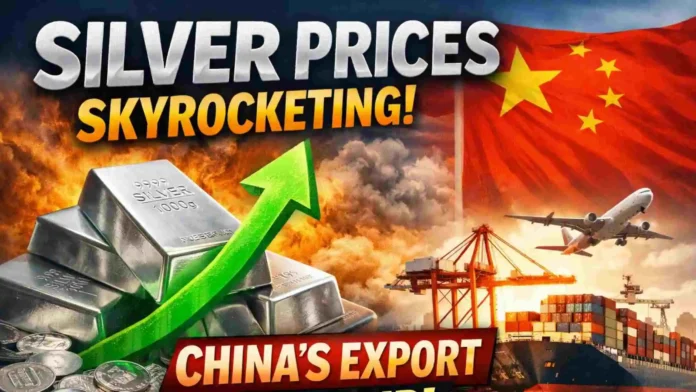
Silver prices have surged to multi-year and near-record highs in 2025, significantly outperforming gold and most industrial commodities. The rally is not driven by speculation alone. Instead, it reflects a convergence of structural supply shortages, booming industrial demand, macroeconomic uncertainty, and a decisive shift in China’s trade and resource policies. Among these factors, China’s tightening control over silver exports has emerged as a critical catalyst accelerating the global price surge.
Silver Prices Over the Past Decade: 2015 to 2025
Silver prices over the last decade show a long period of relative stability followed by an unprecedented breakout in 2025. For much of the 2015–2024 period, silver traded within a narrow range, reflecting balanced supply-demand dynamics. The sharp surge in 2025 marks a clear structural shift in the market.
Historical Silver Prices (USD per Troy Ounce)
| Year | Approximate Average / Year-End Price |
| 2015 | 13.8 |
| 2016 | 16.0 |
| 2017 | 17.1 |
| 2018 | 15.5 |
| 2019 | 16.2 |
| 2020 | 20.7 |
| 2021 | 25.2 |
| 2022 | 21.8 |
| 2023 | 23.6 |
| 2024 | 28.5 |
| 2025 | 75–80 (peak levels) |
Key Phases in the Decade-Long Price Movement
2015–2018: Post-Commodity Downcycle
Silver remained subdued following the global commodity downturn. Prices hovered in the mid-teens, reflecting weak investment demand and steady but unspectacular industrial consumption.
2019–2021: Gradual Recovery and Pandemic Surge
Prices began to recover gradually in 2019 and accelerated sharply during the pandemic years. Safe-haven buying, monetary easing, and a rebound in industrial demand pushed silver above the $25 per ounce mark by 2021.
2022–2024: Consolidation with Upward Bias
Rising interest rates led to a correction in 2022, but silver retained higher support levels compared to earlier years. By 2024, renewed demand from green energy, electric vehicles, and electronics lifted prices close to $30 per ounce.
2025: Historic Breakout
In 2025, silver experienced an extraordinary rally. Prices rose from the low $30s at the beginning of the year to highs approaching $80 per ounce. This surge far exceeded gains seen in the previous decade and was driven by a combination of structural supply shortages, accelerating industrial demand, investment inflows, and tightening export controls by major producing and refining nations, particularly China.
What the Decade-Long Trend Indicates?
For nearly ten years, silver traded in a relatively narrow band, suggesting a market constrained by balanced fundamentals. The explosive move in 2025 represents a decisive break from that pattern and indicates a fundamental repricing of silver in response to long-term supply and demand pressures rather than short-term speculation.
This historical context reinforces the view that the current silver rally reflects a structural shift in the global silver market.
Structural Supply Deficit in the Global Silver Market
The global silver market has been running a supply deficit for several consecutive years. Mine production has failed to keep pace with rising demand due to declining ore grades, underinvestment in exploration, and the fact that most silver is produced as a by-product of copper, lead, and zinc mining rather than from primary silver mines.
At the same time, above-ground inventories held in major vaults and exchanges have been steadily drawn down. This has left the market increasingly sensitive to policy changes and demand shocks, creating the conditions for sharp price movements.
Industrial Demand Is Redefining Silver’s Role
Unlike gold, silver is both a precious metal and a critical industrial input. Industrial usage now accounts for more than half of global silver consumption.
Demand has been rising sharply due to solar photovoltaic manufacturing, where silver is essential for conductive paste; electric vehicles, which use significantly more silver than internal combustion vehicles; electronics, semiconductors, and data infrastructure; and medical and advanced industrial applications
This demand is structural rather than cyclical, meaning it is tied to long-term trends such as energy transition, electrification, and digitalisation.
China’s Central Position in the Silver Ecosystem
China plays a dominant role in the global silver supply chain. It is one of the largest refiners, consumers, and exporters of refined silver, while also being the world’s leading manufacturer of solar panels, electronics, and electric vehicles.
As domestic industrial demand has expanded rapidly, China has increasingly prioritised internal consumption of strategic materials, including silver. This shift has culminated in a major overhaul of its silver export policy.
China’s Silver Export Policy: From Open Trade to State Control
Export Licensing
From January 1, 2026, China will require government-issued licenses for the export of silver. Under the new framework, exporters must obtain approval from the Ministry of Commerce, and shipments without authorisation will not be permitted.
Although the policy stops short of a formal export ban, it places silver exports under direct state supervision, fundamentally changing how silver flows from China to international markets.
How the Licensing Regime Works?
The licensing system is qualification-based. Exporters must meet strict criteria, including minimum production thresholds, financial strength, regulatory compliance, and established trade credentials.
In practical terms, only large, well-capitalised, and often state-affiliated entities are likely to qualify. Smaller refiners and traders are expected to be effectively excluded. As a result, export capacity becomes concentrated among a limited number of government-approved players.
This represents a shift away from market-driven trade toward a centrally managed export regime.
Policy Objectives Behind the Restrictions
Securing Domestic Supply
A primary objective of the policy is to ensure sufficient silver availability for China’s domestic industries. With silver being indispensable to solar energy, electric vehicles, electronics, and high-end manufacturing, Beijing is seeking to prevent supply shortages that could disrupt strategic sectors.
By limiting exports, China ensures that domestic manufacturers have preferential access to refined silver at a time of rising global competition for the metal.
Strategic Resource Management
The export controls also align with China’s broader strategy of treating critical materials as strategic assets. Similar to its past approach to rare earth elements, China is asserting greater control over materials that underpin advanced technologies and clean energy infrastructure.
This allows China to reduce exposure to external supply risks, manage price volatility internally, and strengthen its leverage within global supply chains.
Impact on Global Supply and Prices
China’s export restrictions have tightened an already constrained global market. With fewer approved exporters and reduced outbound volumes, international buyers are facing diminished availability of physical silver.
This reduction comes precisely when demand from green energy, electrification, and investment channels is accelerating. The result has been rising premiums, falling inventories outside China, and upward pressure on global benchmark prices.
Markets have responded by repricing silver to reflect its increasing scarcity, contributing significantly to the sharp rally seen in 2025.
Not a Ban, But a Binding Constraint
While China has not imposed a legal ban on silver exports, the licensing requirement acts as a powerful bottleneck. Exports remain theoretically permissible, but the regulatory hurdles sharply limit actual volumes reaching global markets.
For traders and industrial users, the distinction is largely academic. The policy functions as a supply constraint, reinforcing the perception that silver availability will remain tight for the foreseeable future.
Investment Demand and Macroeconomic Factors
Alongside industrial demand and supply constraints, silver has benefited from macroeconomic conditions. Expectations of interest rate cuts, concerns over inflation, currency debasement, and geopolitical uncertainty have driven investors toward hard assets.
Silver’s dual identity as an industrial metal and a store of value has amplified these flows, with ETF inflows and physical investment further tightening supply.
Conclusion
The surge in silver prices reflects a fundamental realignment of the global silver market. Structural supply deficits, accelerating industrial demand, and China’s strategic export controls have combined to create a materially tighter market.
China’s export policy, in particular, marks a turning point. By prioritising domestic use and placing exports under state control, Beijing has reinforced silver’s status as a strategic resource. As long as these conditions persist, silver prices are likely to remain elevated and volatile, driven not by speculation alone, but by enduring structural forces.
Read More: PMLA Twin Condition Inapplicable On Woman Arrested 9 Years After Alleged Transactions: Delhi HC

