
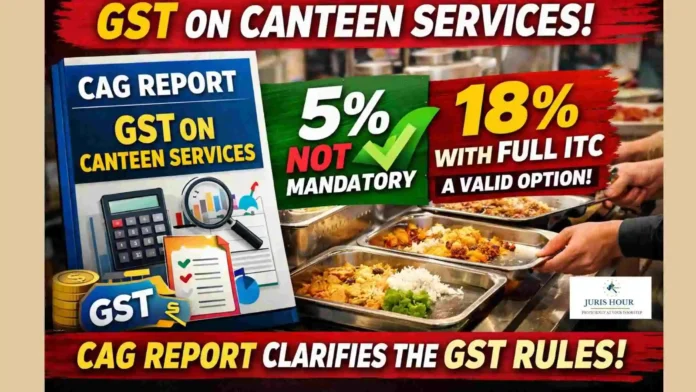
For years, businesses providing canteen services have operated under a cloud of uncertainty on the applicable GST rate. The dominant belief across industry was that the 5 per cent GST rate without Input Tax Credit (ITC) was mandatoryfor canteen services. Since the law did not explicitly provide an alternative rate option—unlike Goods Transport Agency (GTA) services—most taxpayers assumed there was no choice.
The prevailing mindset was simple and widespread:
“If you run a canteen, you must charge 5 per cent GST and forget about your tax credits.”
This belief was further reinforced by precedents under the pre-GST regime, where courts often held that concessional rates, once prescribed, were compulsory and not optional.
Legal Framework: Conditional Concessional Rate
Notification No. 13/2018–Central Tax (Rate) dated 26 July 2018 introduced a concessional GST rate of 5 per cent on supply, by way of or as part of any service, of food or beverages by a restaurant, eating joint, mess, or canteen, whether for consumption on or away from the premises.
However, this benefit comes with a clear and strict condition:
Input tax charged on goods and services used in supplying the service must not be taken.
CAG Audit Finding: Conditions Not Met
In its latest report, the Comptroller and Auditor General of India (CAG) has brought clarity to this long-standing dilemma. The audit examined a taxpayer under the Bengaluru West Central Tax Commissionerate who was supplying food and beverages to its employees through a canteen for consideration and paying GST at the concessional 5 per cent rate.
While the taxpayer did not avail ITC on goods or services exclusively used for the canteen, the audit revealed that ITC had been claimed on common input services, including:
- Facility management
- Security services
- Housekeeping
- Pest control
These services also covered the canteen premises. The CAG categorically noted that availing ITC on such common services amounts to non-fulfilment of the “no ITC” condition prescribed under Notification No. 13/2018.
Big Shift in Interpretation: 5% Is a Benefit, Not a Compulsion
The CAG report makes a crucial distinction: the 5 per cent rate is a conditional benefit, not a forced rule. Once the condition of non-availment of ITC is breached—even indirectly through common services—the taxpayer becomes ineligible for the concessional rate altogether.
As a result, GST on canteen services must be paid at the standard rate of 18 per cent under SAC 996339. Importantly, once taxed at 18 per cent, the supplier becomes entitled to full ITC on all eligible inputs and input services.
Revenue Impact and Departmental Action
The audit quantified the short payment of GST at ₹5.91 crore for the period 2018–19 to 2020–21. Following the audit objection raised in November 2023, the Ministry informed the CAG (in April 2025) that a Show Cause Notice (SCN)was issued in December 2023, demanding the differential tax along with applicable interest.
Wider Implications Beyond Canteen Services
This audit observation has implications far beyond corporate canteens. The same logic could apply to other sectors operating under “single-entry” concessional GST rates, such as:
- Economy air travel
- Transportation services
- Other service categories with a lower rate linked to a “no ITC” condition
The report opens up a strategic and compliance-level conversation for businesses. It suggests that the 5 per cent rate is not a restriction but a choice. Where the benefit of availing full ITC outweighs the advantage of a lower output tax rate, adopting the 18 per cent GST route may not only be legally safer but also commercially prudent.
Not Settled Law, But a Strong Signal
While a CAG report represents an audit view and not binding law or a formal circular, it carries significant persuasive value. It is likely to influence departmental audits, future litigation, and policy clarifications.
The message for taxpayers is clear: you cannot mix a concessional rate with ITC, even indirectly. Either strictly forgo ITC and pay 5 per cent, or consciously adopt 18 per cent with full credit. Anything in between could invite substantial tax demands, interest, and prolonged litigation.
Read More: Sketchy Investigation | Allahabad HC Grants Interim Bail to Advocate Accused Of Sexual Exploitation

