
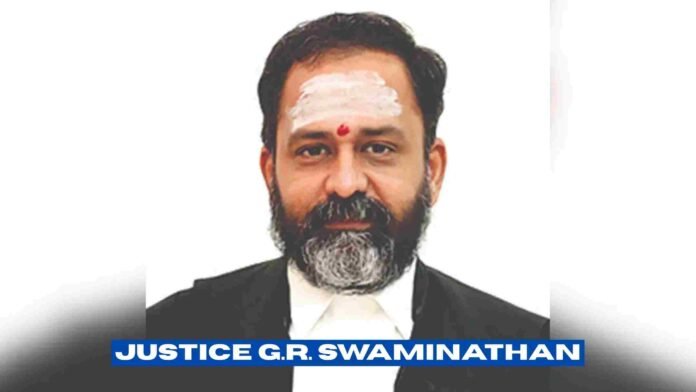
A group of former Supreme Court Judges, former Chief Justices, and Judges of various High Courts have issued a powerful “Statement of Solidarity & Call to Protect Independence of Judiciary,” opposing the move by certain Members of Parliament and senior advocates to initiate impeachment proceedings against Justice G.R. Swaminathan of the Madras High Court.
They describe the impeachment attempt as a brazen effort to intimidate judges who do not align with the ideological expectations of a particular political or social constituency. According to them, if such a move were allowed to proceed, it would strike at the very roots of India’s democratic structure and compromise the independence of the judiciary.
The signatories emphasize that even if the allegations cited by the MPs are assumed to be true, the reasons are wholly insufficient to warrant the extraordinary constitutional mechanism of impeachment. They underline that impeachment is meant only for the gravest cases of misconduct, and using it casually would set a dangerous precedent.
Recalling past episodes where the judiciary faced political pressure, the former judges draw attention to events during the Emergency period, including the supersession of Supreme Court judges after the Kesavananda Bharati decision and the sidelining of Justice H.R. Khanna following his iconic dissent in ADM Jabalpur. These incidents, they warn, are historical reminders of how political overreach can weaken judicial autonomy.
The statement argues that the current controversy is not an isolated incident. Instead, it falls within a pattern where political actors have repeatedly attempted to discredit or pressure the higher judiciary whenever judicial decisions do not suit their interests. The unprecedented effort in 2018 to impeach then Chief Justice Dipak Misra, the public campaigns against Chief Justices Ranjan Gogoi, S.A. Bobde, and Dr. D.Y. Chandrachud, and the recent attacks directed at incumbent CJI Surya Kant are cited as examples of this troubling trend.
The former judges caution that impeachment is a constitutional safeguard meant to protect the integrity of the judiciary, not a weapon to enforce ideological conformity. Using the threat of impeachment as a method of coercion, they assert, is anti-democratic and undermines the rule of law. They warn that while today’s target may be one judge, tomorrow it could be the entire institution.
In conclusion, the signatories call upon all stakeholders — Members of Parliament across political lines, members of the Bar, civil society, and the general public — to oppose this move unequivocally and ensure that it is halted at the very outset. They insist that judges must remain accountable to their constitutional oath, not to partisan pressures or ideological intimidation. The statement ends with a clear message: in a constitutional democracy, judgments are to be challenged through appeals and legal scrutiny, not through threats of impeachment.
Read More: Supreme Court Stays HC’s Finding on Munambam Land; Status Quo to Continue Till January 27

