
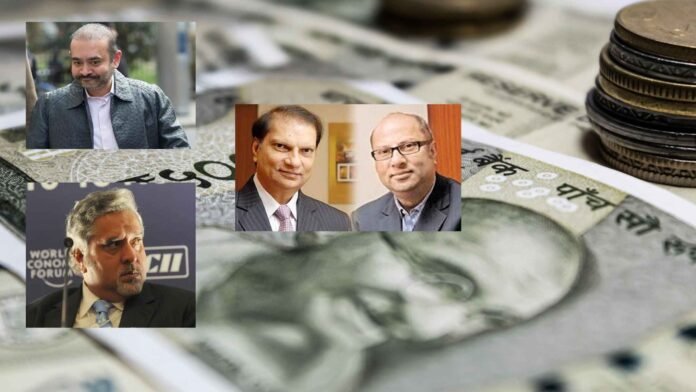
The Union Government has informed Parliament that a total of 15 individuals have been declared Fugitive Economic Offenders (FEOs) under the Fugitive Economic Offenders Act, 2018, as of 31 October 2025. Of these, nine offenders are linked to major financial frauds involving Public Sector Banks (PSBs), resulting in massive losses running into thousands of crores.
The data was presented in the Lok Sabha in response to an unstarred question, where Minister of State for Finance Shri Pankaj Chaudhary laid out comprehensive bank-wise and offender-wise financial details.
Massive Losses: Over ₹26,645 Crore Hit to Banks
According to the compiled figures across PSBs, the total financial loss attributed to the declared FEOs stands at an estimated ₹26,645 crore, while interest accrued on these stressed accounts has pushed the overall outstanding to more than ₹31,437 crore.
Some of the biggest losses were reported in cases involving:
- Vijay Mallya (Kingfisher Airlines) – State Bank of India reported a loss of over ₹6,848 crore, with other PSBs including Union Bank, Punjab & Sind Bank, and UCO Bank also taking hits.
- Nirav Modi & associated entities – Punjab National Bank reported substantial losses including ₹6,799 crore in “non-borrowal fraud,” apart from other banks such as SBI, BoI, BoB, Canara Bank, and Central Bank of India.
- Nitin and Chetan Sandesara Group (Sterling Biotech, Sterling SEZ, Sterling Global Oil Resources) – Multiple banks collectively reported losses running into thousands of crores.
Recoveries Still Limited; Only Two Cases Settled Through OTS
Though the government has emphasised its multi-pronged recovery approach, the actual recoveries remain comparatively modest.
- Only two fugitive economic offenders have been able to negotiate settlements under the One Time Settlement (OTS) schemes with banks.
- The data reveals settled amounts in a few Sandesara Group-linked cases, where discounts were approved at the board level for specific accounts.
- However, most major accounts—including those linked to Nirav Modi and Vijay Mallya—show “N” (No) under OTS, indicating no negotiated settlements have taken place.
The annexure reveals that while ₹19,187 crore has been recovered across various accounts, the aggregate outstanding amount continues to remain far larger.
No New Policy to Pre-empt Offenders from Leaving India
In a pointed question regarding whether the Government plans to formulate a policy to legally ban or place potential offenders on a watchlist before they flee the country, the Finance Ministry responded in the negative.
The reply clarifies that:
- No new policy is currently under formulation to automatically bar or track individuals before they depart India.
- Existing mechanisms under immigration alerts, Look-Out Circulars (LOCs), and financial intelligence systems continue to operate within their current framework.
Key Offenders and Bank-Wise Exposure
The annexure table supplied to Parliament details nearly 50+ major bank accounts linked to offenders such as:
- Nirav Modi
- Vijay Mallya
- Nitin, Chetan, and Dipti Sandesara
- Sudarsan Venkatraman & Ramanujam Sesharathnam (Zylog Systems)
- Pushpesh Kumar Baid
These accounts span major PSBs including:
- State Bank of India
- Punjab National Bank
- Bank of Baroda
- Canara Bank
- Bank of India
- UCO Bank
- Central Bank of India
- Indian Overseas Bank
- Indian Bank
- Union Bank of India
- Punjab & Sind Bank
Financial exposures vary widely—from ₹20 crore to over ₹6,800 crore per account, highlighting the scale of fraud faced by India’s banking sector during the past decade.
FEO Act as a Recovery Tool
The Fugitive Economic Offenders Act, 2018 enables authorities to:
- Declare absconding economic offenders as FEOs,
- Allow confiscation of their properties in India and abroad,
- Deter offenders from evading legal proceedings by staying outside the country.
The Act applies to offences involving ₹100 crore and above.
Conclusion
The government’s updated figures underline the substantial, multi-bank impact caused by a handful of economic fugitives. While the FEO declaration mechanism has helped escalate recovery efforts, only limited settlements and recoveries have taken place so far, and the overall outstanding amounts remain staggering.
With the government confirming that no new preventive policy is on the anvil, the issue of early detection and timely travel restrictions for high-risk economic offenders is likely to remain a subject of debate inside and outside Parliament.
Read More: 2,500 Offenders Booked In Three Years: Lok Sabha Reply Shows Intensified Crackdown By Customs & DRI

