
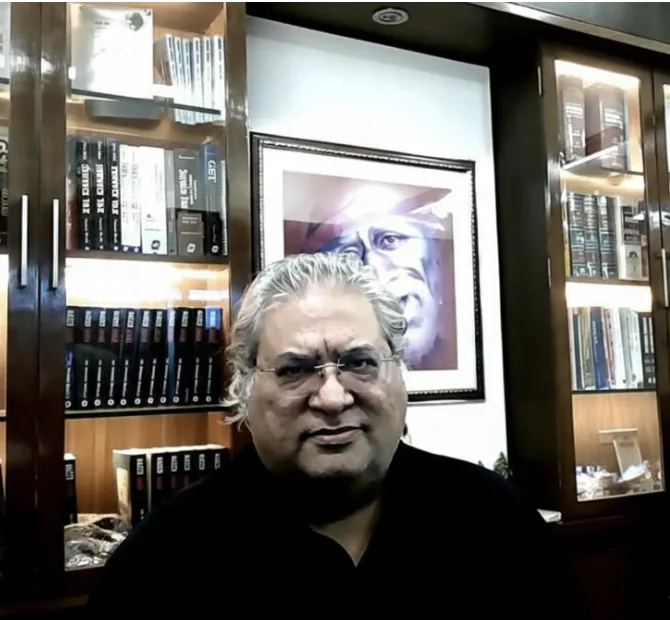
This Article pertaining to “Pandora’s Box for GSTAT – Risk of Reboot?” is written by Dr Monish Bhalla. He is a distinguished author, legal expert, and former officer of India’s Narcotics Control Bureau (NCB). With 37 years in public life, Dr. Bhalla has been a key figure in drug law enforcement and indirect taxation in India. His expertise in the fields of GST, Customs, and narcotics control has made him a leading voice in legal reforms and national policy. He is also a well-known columnist and has authored several books on GST, drug trafficking, and legal matters.
Do Age Bars, Tenures, and Selections Need a Complete Re-Do?
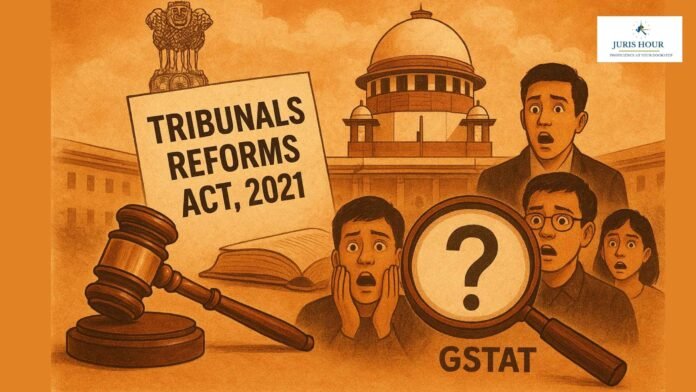
A tremor ran through India’s legal system on November 19, 2025—quiet in sound, but explosive in consequence. The Supreme Court did not merely pronounce another judgment; it dismantled the very pillars on which India’s tribunal system has stood since 2021. In a passing but powerful observation, the Court in Madras Bar Association v. Union of India struck down key parts of the Tribunals Reforms Act, 2021 for undermining judicial independence, effectively resetting the framework for appointments and service conditions across tribunals.
The Supreme Court’s ruling dismantled several core provisions that shaped the very architecture of tribunal appointments. The Court struck down the 50-year minimum age requirement in Section 3, declaring it arbitrary and unconstitutional. It also invalidated the four-year tenure prescribed under Section 5 and reinstated the longer, five-year term to uphold institutional independence. The earlier system that required the Search-cum-Selection Committee to forward two names per vacancy was also rejected; the Court held that only a single name must be recommended to prevent undue executive influence. Further, the re-appointment mechanism under Section 6 has been tightened, with the Court clarifying that any re-appointment must undergo the same rigorous process as an initial appointment.
And in the middle of this legal earthquake stands the nation’s youngest tribunal: the GST Appellate Tribunal (GSTAT). Barely constituted, barely functional, already carrying the burden of thousands of pending GST disputes—and suddenly staring at an existential question…and the more we discuss , the more questions are pouring in from all quarters.
If the foundation of appointment rules is unconstitutional, what becomes of the people appointed under them?
Do their appointments survive?
Do their decisions stand?
Do their very chairs remain valid—or do they vanish into a legal vacuum?
This is where the story turns into a true Pandora’s Box.
Under the struck-down provisions, strict age caps and short four-year terms had already filtered out many senior judicial figures. Now that those restrictions are gone, what happens to those who were excluded? Do they have a claim to demand reconsideration?
And if they do—must the entire selection process be redone?
Will panels be reconvened?
Will interviews be repeated?
Will current appointments have to be revalidated under a new, constitutionally compliant architecture?
The Supreme Court has mandated the creation of a National Tribunals Commission within four months—an independent body that will take charge of appointments, tenure, service conditions, and oversight. But when this Commission turns its gaze towards GSTAT, what will it find?
Will it endorse the current appointments?
Or will it rewrite the rulebook and reorder the entire roster?
If service conditions change—age, tenure, pay, reappointment—can existing appointments legally stand?
And if the appointment itself is open to challenge, what about the orders passed by that bench?
Could every decision be argued as void?
Could every litigant question the tribunal’s legitimacy?
GSTAT’s jurisprudence is still an infant. It has not yet built the authority that comes from years of consistent decisions. But before it can even begin shaping GST law, it is caught in a storm over its own structural validity.
Taxpayers, businesses, and professionals expected GSTAT to bring clarity, consistency, and timely justice. Instead, they face a haze of uncertainty.
Will GSTAT rise from this procedural chaos as a stronger, constitutionally sound appellate institution?
Or will its early years be dominated by challenges to its very existence?
Will India’s long-awaited GST dispute mechanism finally stabilize—or stumble under the weight of legal doubt?
The lid of Pandora’s Box is open, and the questions are flying.
The answers, however, are yet to emerge.

